



















Introduction: The Intersection of AI and Healthcare
Artificial Intelligence (AI) is dramatically transforming the healthcare landscape, with applications ranging from early disease detection to enhancing the accuracy of medical diagnoses. One of the most promising and revolutionary applications of AI lies in its ability to assist in pathological image recognition, disease diagnosis, and the development of personalized treatment plans. These advancements are not only reshaping the way healthcare professionals approach patient care but are also creating new opportunities to enhance outcomes, reduce healthcare costs, and improve overall patient satisfaction.
In pathology, where images such as microscopic slides, X-rays, and CT scans are essential for diagnosing diseases, AI has proven to be an invaluable tool. By automating the analysis of medical images, AI systems can detect abnormalities with high accuracy, providing healthcare professionals with valuable insights to support their decision-making processes. Furthermore, AI’s integration with clinical data enables the development of personalized treatment plans tailored to an individual’s unique medical condition and genetic makeup.
This article delves into how AI is revolutionizing these aspects of healthcare, the technologies behind it, its current applications, and the potential for future advancements in the field.
1. The Role of AI in Pathological Image Recognition
1.1 What is Pathological Image Recognition?
Pathological image recognition refers to the process of analyzing medical images (such as histopathological slides, X-rays, and MRI scans) to identify abnormalities that indicate the presence of diseases like cancer, infections, and autoimmune disorders. Traditionally, pathologists rely on manual examination of these images under a microscope to identify key patterns. However, human interpretation is prone to errors, especially when handling vast amounts of data or complex images.
AI, particularly deep learning algorithms, can analyze these images much faster and more accurately than the human eye. By training AI models on large datasets of labeled medical images, these systems can learn to recognize subtle patterns that might be overlooked in traditional analysis.
1.2 The Role of Deep Learning in Pathological Image Recognition
The use of Convolutional Neural Networks (CNNs), a type of deep learning algorithm, has significantly advanced the ability of AI to recognize pathological images. CNNs excel at processing grid-like data (such as images) by learning hierarchical patterns at multiple levels.
For instance, in cancer diagnosis, CNN-based models are trained on images of tissue samples and can identify the presence of malignant cells with a high degree of accuracy. These models can also segment and classify various components of an image, such as tumors, cell structures, and blood vessels, which are critical for diagnosis.
1.3 Benefits of AI in Pathological Image Recognition
- Accuracy: AI models, when trained on large datasets, can achieve diagnostic accuracy comparable to or even exceeding human experts. Studies have shown that AI systems can correctly identify abnormalities in medical images at a higher rate than pathologists in certain cases.
- Efficiency: AI’s ability to rapidly analyze images saves time in the diagnostic process. Pathologists can focus on more complex cases, while AI handles routine or preliminary analyses, leading to faster diagnosis and treatment initiation.
- Consistency: AI systems are not prone to fatigue or subjective biases, ensuring consistent results regardless of workload or time of day.
Real-World Example:
Google’s DeepMind has developed AI models that can analyze eye scans and predict conditions like diabetic retinopathy and age-related macular degeneration. These systems have outperformed human doctors in terms of diagnostic accuracy and have the potential to be widely deployed in clinical settings.
2. AI in Disease Diagnosis: A Transformative Approach
2.1 AI’s Role in Disease Diagnosis
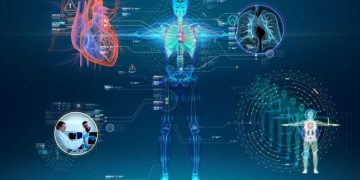
In the diagnostic phase of healthcare, the ability to accurately and quickly identify diseases is paramount. AI is revolutionizing this process by aiding in the identification of diseases from various medical imaging modalities, including X-rays, MRI scans, CT scans, and ultrasound. AI systems are trained to detect a wide variety of conditions, such as cancer, cardiovascular diseases, and neurological disorders.
AI assists in disease diagnosis through:
- Image analysis: AI’s ability to automatically analyze images for anomalies enables faster and more accurate detection of conditions such as cancer (e.g., breast cancer, lung cancer), heart disease, pneumonia, and more.
- Pattern recognition: AI algorithms excel at identifying patterns within large datasets, which can be particularly helpful in detecting rare or subtle diseases that may be missed by human doctors.
- Predictive analytics: AI can also leverage historical medical data and clinical records to predict the likelihood of disease onset, enabling early intervention and better management of chronic conditions.
2.2 AI in Cancer Diagnosis
Cancer diagnosis has been one of the most significant areas where AI has made an impact. Early detection is crucial in improving survival rates, and AI systems can analyze medical images such as mammograms, biopsies, and CT scans to identify potential signs of cancer with great precision.
AI models trained on millions of images can identify subtle patterns such as abnormal cell growth, texture changes, or irregularities in blood vessels that might signal the presence of a tumor. Once a potential tumor is detected, AI can help further analyze its characteristics (e.g., size, shape, and borders), which can help clinicians determine the best course of treatment.
Real-World Example:
PathAI, a company specializing in AI-powered pathology, has developed AI algorithms that assist pathologists in diagnosing breast cancer and melanoma with greater accuracy. The AI model has demonstrated a diagnostic accuracy rate of up to 98%, significantly improving the speed and precision of diagnoses.
2.3 AI in Cardiology and Neurology
Beyond cancer, AI is playing a crucial role in diagnosing cardiovascular diseases and neurological conditions.
- Cardiology: AI algorithms can analyze electrocardiograms (ECGs), echocardiograms, and MRI scans to detect abnormalities like arrhythmias, heart attacks, and other cardiac conditions. These AI systems can also predict the risk of heart disease, enabling preventative care.
- Neurology: AI is being used to diagnose neurological disorders like Alzheimer’s disease, Parkinson’s disease, and stroke. By analyzing brain scans and patient history, AI can identify early signs of these conditions, allowing for early interventions and more effective treatments.
3. Personalized Treatment Plans Powered by AI
3.1 What is Personalized Medicine?
Personalized medicine refers to tailoring medical treatment to the individual characteristics of each patient, such as their genetic makeup, lifestyle, and unique disease profile. Unlike the traditional “one-size-fits-all” approach, personalized medicine allows for more precise and effective treatment plans.
AI plays a critical role in personalized medicine by analyzing large volumes of patient data to create customized treatment protocols. By examining factors such as genetic sequencing, clinical history, and environmental factors, AI can identify the most effective therapies for each individual.
3.2 AI in Genomics and Drug Development
AI’s role in genomics has been particularly transformative. By analyzing the genetic data of patients, AI can help identify genetic markers associated with diseases and predict how patients will respond to specific drugs.
- Genomic Analysis: AI systems can analyze large-scale genomic data to identify mutations that could predispose individuals to certain diseases, such as cancer or cardiovascular diseases. This information can help doctors design targeted treatments based on the patient’s genetic profile.
- Drug Discovery: AI accelerates the process of drug discovery by predicting how different molecules will interact with biological targets. AI can analyze large libraries of compounds to identify those most likely to be effective in treating a specific disease, drastically reducing the time and cost involved in traditional drug development.
Real-World Example:
Tempus, a technology company that uses AI in the field of oncology, combines clinical and molecular data to assist oncologists in developing personalized treatment plans for cancer patients. The company uses AI to analyze genomic data, providing doctors with recommendations based on the latest research.
3.3 AI in Treatment Optimization
AI can also optimize the administration of treatments. For example, in radiotherapy, AI can help determine the most effective dose of radiation and the precise targeting of tumors, minimizing damage to healthy tissues.
Additionally, AI can monitor patients’ responses to treatment in real-time and make adjustments as needed, ensuring that the patient receives the most effective care at each stage of their treatment journey.
4. Future Prospects and Challenges in AI-Assisted Healthcare
4.1 Future Prospects
The future of AI in healthcare looks promising. As the technology evolves, AI systems will become even more sophisticated, capable of handling more complex tasks and integrating seamlessly with electronic health records (EHR) and other medical systems. The use of AI in robotic surgery, drug delivery, and real-time diagnostics will continue to expand, enhancing the overall healthcare experience.
4.2 Ethical and Regulatory Considerations
Despite the promise of AI in healthcare, there are still challenges that need to be addressed. These include concerns related to data privacy, the ethical use of AI, and regulatory oversight. It will be essential to establish clear frameworks for the use of AI in medical decision-making, ensuring that AI systems operate with the utmost accuracy and fairness.
Conclusion: AI’s Impact on Healthcare is Just Beginning
AI is transforming the healthcare industry, enabling more accurate disease diagnosis, enhancing pathological image recognition, and supporting the development of personalized treatment plans. As the technology continues to evolve, AI will become an indispensable tool in providing more precise, efficient, and tailored care. By leveraging AI’s potential, healthcare professionals can improve patient outcomes, reduce costs, and ultimately enhance the overall quality of healthcare worldwide. However, its integration must be done thoughtfully, with attention to ethical, regulatory, and privacy considerations, ensuring that AI becomes a force for good in healthcare.