


















Abstract
Artificial intelligence (AI) has traditionally operated with a single-modal input, whether it’s text, image, audio, or another format. However, the field has undergone a transformative shift with the development of multimodal AI systems that can process and integrate multiple types of inputs simultaneously. This progression is fundamentally changing how AI models understand the world, enabling more nuanced reasoning, richer representations, and better decision-making capabilities. This article explores the evolution of AI from single-input systems to sophisticated multimodal architectures, examining the technological advances, challenges, and applications that are shaping the future of AI. It also discusses how multimodal systems are set to revolutionize various industries, from healthcare and education to entertainment and autonomous vehicles.
1. Introduction: The Traditional Boundaries of AI Systems
1.1 The Rise of Single-Input AI
In its early stages, AI systems were primarily designed to handle single input types:
- Image-based AI (e.g., computer vision for object detection, facial recognition).
- Text-based AI (e.g., natural language processing for sentiment analysis, chatbots).
- Audio-based AI (e.g., speech recognition, voice assistants).
These systems were optimized for specific tasks, excelling in their respective domains. However, the lack of cross-domain integration meant they were often limited in their ability to understand and interact with real-world complexities, where inputs are inherently multimodal. For example, a self-driving car might need to process video footage, sensor data, and audio inputs simultaneously, which required a different approach than traditional single-modal AI systems could handle.
1.2 The Shift to Multimodal AI
The multimodal revolution in AI is driven by the realization that human intelligence itself is inherently multimodal. Humans perceive and process the world through a combination of vision, sound, touch, and language, and AI is now beginning to follow suit. Multimodal systems aim to:
- Integrate various forms of data (e.g., text, images, sound, sensor data) for a more comprehensive understanding of the environment.
- Generate richer representations that combine information across domains, improving reasoning and decision-making.
- Perform tasks that require cross-modal understanding, such as captioning images, answering questions based on both text and images, and enabling multimodal interactions in virtual assistants.
This shift is opening up new possibilities for AI applications and expanding the scope of tasks AI systems can handle.
2. Technological Advances Enabling Multimodal AI
2.1 Neural Networks and Transformers: The Core of Multimodal Integration
The development of transformer models, initially pioneered by BERT and GPT, has been key to advancing multimodal AI. These models have been adapted to handle various data types through several important innovations:
- Cross-attention mechanisms: Transformers can attend to features across different input types (text, image, speech) and build relationships between them. This allows for more accurate contextual understanding and decision-making.
- Pretraining on multiple modalities: Large transformer-based models like CLIP (Contrastive Language–Image Pretraining) and DALL·E (an AI model that generates images from text prompts) have been trained on massive datasets that combine text and images, allowing them to generate and interpret information across modalities seamlessly.
- Multitask learning: Models such as T5 (Text-to-Text Transfer Transformer) have been adapted to handle a variety of tasks simultaneously by training on multimodal datasets. This enables AI to perform multiple related tasks—such as language translation, summarization, and question-answering—on a single set of input data.
2.2 Deep Learning Architectures for Multimodal Inputs
Recent innovations in deep learning architectures have made it possible to integrate multiple input modalities effectively:
- Multimodal Variational Autoencoders (VAEs): These models generate latent representations that unify different types of data. For example, they can create a shared representation of an image and a corresponding caption.
- Multimodal Generative Adversarial Networks (GANs): These GANs can generate realistic outputs, such as images based on textual descriptions or music from visual stimuli, by learning the relationship between different input types.
- Multimodal Transformers: Hybrid models like VisualBERT, ViLBERT, and UNITER combine vision and language processing in a unified model architecture, enabling them to understand and generate multimodal content.
2.3 Data Fusion and Alignment Techniques
A key challenge in multimodal AI is data fusion—combining diverse input types into a coherent and unified model. Techniques include:
- Feature alignment: Mapping features from different domains (e.g., aligning textual descriptions with visual elements).
- Cross-modal contrastive learning: This technique trains models to learn by contrasting different modalities, allowing them to correlate concepts across text, images, or sound.
This fusion of data types results in more robust and flexible models that can process and make sense of richer inputs.
3. Multimodal AI Applications Across Industries
3.1 Healthcare
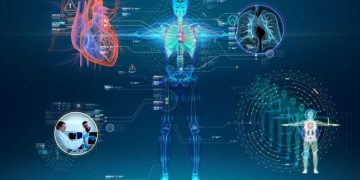
In healthcare, multimodal AI is enabling advanced diagnostic tools, personalized treatments, and patient care solutions:
- Medical image analysis: AI can analyze both radiological images and clinical text (e.g., patient records) to identify conditions and recommend treatments.
- Predictive analytics: Combining genetic data, medical history, and environmental factors enables AI to make more accurate predictions about patient health and potential diseases.
- Robotic surgery: Surgical robots use a variety of inputs, such as video feeds, real-time sensor data, and voice commands, to assist surgeons in complex procedures.
Example: Systems like IBM Watson Health are already integrating multimodal AI to interpret medical imaging alongside patient data, improving diagnostic accuracy and treatment outcomes.
3.2 Autonomous Vehicles
For autonomous vehicles, multimodal AI is crucial in perception, navigation, and decision-making:
- Sensor fusion: AI systems combine inputs from LIDAR, radar, cameras, and ultrasonic sensors to build a detailed understanding of the vehicle’s environment.
- Path planning and decision-making: By processing data from multiple modalities, autonomous systems can better predict obstacles, pedestrians, and other vehicles, leading to more precise navigation and safer driving.
Example: Companies like Waymo and Tesla use multimodal AI to create self-driving cars that perceive the environment holistically, making real-time decisions to ensure safety.
3.3 Consumer Technology
Multimodal AI has revolutionized consumer-facing products, enhancing user experience across various applications:
- Virtual assistants: AI-driven assistants like Google Assistant, Siri, and Alexa integrate voice commands with contextual understanding of user behavior, enabling them to handle requests involving diverse data types (e.g., calendar events, music preferences, web searches).
- Augmented reality (AR): Multimodal AI enhances AR systems by combining visual data from cameras with audio input or user gestures to provide immersive experiences in gaming, shopping, and education.
Example: Apple’s Siri processes both voice input and contextual data (like location and calendar events) to provide personalized and accurate responses.
3.4 Entertainment and Media
In entertainment, multimodal AI is enabling new ways of creating and consuming content:
- Interactive media: AI models analyze both audio and video to generate real-time reactions and immersive environments for virtual reality (VR) or augmented reality (AR) experiences.
- Content generation: Tools like DALL·E and GPT-3 enable creators to generate both text and visuals, making them powerful assistants in media production, advertising, and content marketing.
- Sentiment analysis: AI can analyze text, audio, and video to gauge public sentiment about movies, products, or services, providing valuable insights for marketers and creators.
4. Challenges in Multimodal AI Development
4.1 Data Availability and Quality
Multimodal AI systems require large, high-quality datasets that span different modalities, but such data is often scarce or difficult to obtain:
- Data alignment: Ensuring that data from multiple modalities are aligned and relevant to each other is crucial for accurate learning.
- Data labeling: The need for labeled data across multiple domains can make training multimodal systems resource-intensive and time-consuming.
4.2 Computational Complexity
Training multimodal models requires significant computational power:
- Large-scale architectures: Models like GPT-3 and CLIP require vast amounts of computing resources and data to train effectively.
- Real-time processing: Multimodal systems that process inputs in real-time (e.g., self-driving cars, live translation) face the challenge of achieving both high accuracy and low latency.
4.3 Interpretability and Explainability
The complexity of multimodal models makes them harder to interpret and explain:
- Black-box models: Multimodal systems often lack transparency, making it difficult to understand why a certain decision was made.
- Ethical concerns: The ability to explain how a multimodal system arrived at its conclusion is essential, especially in high-stakes applications like healthcare or legal analysis.
4.4 Generalization Across Modalities
Ensuring that multimodal AI systems generalize well across diverse environments and inputs remains a challenge:
- Domain adaptation: Models may struggle when transferring knowledge from one domain (e.g., medical imaging) to another (e.g., general object recognition).
- Bias and fairness: Multimodal systems must be carefully calibrated to avoid amplifying biases present in any individual modality (e.g., biased text data or skewed image datasets).
5. The Future of Multimodal AI
5.1 Towards Human-like Understanding
The ultimate goal of multimodal AI is to approach a human-like level of understanding, where the system can seamlessly process and reason across multiple input types as humans do. This could lead to breakthroughs in:
- General artificial intelligence: AI systems that can perform a wide range of tasks, from scientific discovery to creative expression, across multiple modalities.
- Human-robot interaction: Robots that can understand and respond to a combination of spoken commands, visual cues, and gestures in real-time.
5.2 Integration with Internet of Things (IoT)
Multimodal AI will be central to IoT ecosystems, where devices will interact and make decisions based on inputs from sensors, user commands, and contextual information. This will enable smarter, more autonomous environments.
6. Conclusion
Multimodal AI represents the next frontier in artificial intelligence, where systems are no longer confined to processing a single type of input. As AI continues to evolve, the ability to handle and integrate diverse data types will enable more advanced, human-like systems with far-reaching applications across industries. The challenges in data alignment, computational complexity, and interpretability are substantial, but the potential rewards are transformative. From healthcare and autonomous vehicles to entertainment and consumer technology, multimodal AI is poised to drive the future of intelligent systems.