

















Introduction
The development of artificial intelligence (AI) has led to significant advancements in numerous fields, from natural language processing (NLP) to computer vision and healthcare. However, one of the most persistent challenges has been the need for large amounts of labeled data to train AI models effectively. Traditionally, AI models rely on manually labeled datasets—collections of data where each sample is paired with a label or category, indicating the output the model should learn to predict.
While labeling data is an essential part of supervised learning, it comes with significant costs, both in terms of time and resources. Data labeling is typically a labor-intensive and expensive process, particularly for large datasets. Furthermore, the quality of labeled data can heavily influence the performance of AI models. This dependency on manually labeled data has been one of the bottlenecks in scaling AI technologies, especially in industries where labeled data is scarce or difficult to obtain.
In recent years, a promising solution has emerged in the form of self-supervised learning (SSL). By reducing the reliance on human-annotated data, self-supervised learning offers a more scalable and cost-effective alternative for training AI models. In this article, we will explore the concept of self-supervised learning, its benefits, applications, and the potential it holds for the future of AI development.
1. Understanding Self-Supervised Learning (SSL)
1.1 What Is Self-Supervised Learning?
Self-supervised learning is a type of unsupervised learning where AI models can learn useful representations of data without requiring manually labeled examples. Instead of relying on explicit labels, SSL algorithms generate labels from the data itself. This can be achieved through a variety of techniques, such as predicting missing parts of the data or learning to predict the context of a given sample.
For example, in natural language processing, self-supervised models can predict the next word in a sentence or fill in a missing word. In computer vision, models might learn to predict the missing parts of an image based on the surrounding context. By leveraging latent structure and inherent patterns in data, SSL algorithms can learn valuable features without needing large amounts of manually labeled data.
1.2 The Difference Between Self-Supervised and Supervised Learning
The primary difference between supervised learning and self-supervised learning lies in the way data is prepared for training:
- Supervised Learning: In supervised learning, the algorithm learns from labeled data, where each input is paired with a corresponding output label. This process requires a significant amount of human effort to label the data. For example, in image classification, each image must be labeled with the correct class, such as “dog” or “cat.”
- Self-Supervised Learning: In SSL, the model learns from data that does not require explicit labeling. Instead, it uses parts of the data itself to create a supervisory signal. For instance, in an image dataset, the model may learn to predict missing parts of an image or predict transformations applied to the data.
While supervised learning has been the foundation of most traditional machine learning tasks, self-supervised learning is rapidly gaining traction as an effective alternative, especially for tasks where labeled data is scarce or costly to obtain.
2. How Self-Supervised Learning Reduces the Dependency on Labeled Data
2.1 Cost Reduction
The most significant advantage of self-supervised learning is its ability to drastically reduce the cost of training AI models. In traditional supervised learning, obtaining labeled data requires hiring annotators or using expensive tools, leading to high costs for both time and money. Self-supervised learning eliminates or significantly reduces this step, making it possible to train powerful models using vast amounts of unlabeled data, which is much easier and cheaper to obtain.
For example, instead of manually labeling millions of images, self-supervised models can learn from a dataset of images without needing explicit labels. This makes scaling AI solutions to large datasets more feasible, particularly in industries where labeled data is difficult to acquire, such as healthcare, where labeling medical images requires expertise and time.
2.2 Improved Data Efficiency
Self-supervised learning is more data-efficient because it can learn from large amounts of unlabeled data. In many domains, such as speech recognition or computer vision, large amounts of unlabeled data are readily available but manually labeling this data is impractical. SSL allows models to exploit this unlabelled data by creating pseudo-labels or contextual labels, thus enhancing the efficiency of learning.
For example, in speech-to-text systems, self-supervised models can learn from raw speech data by predicting future parts of the speech signal based on the context. These models can then be fine-tuned for downstream tasks such as transcription with a smaller set of labeled data.
2.3 Reducing the Need for Expert Involvement
Manually labeling data often requires domain expertise. In fields like medical imaging, labels must be provided by trained radiologists, which can be both time-consuming and expensive. With self-supervised learning, the dependency on domain-specific expertise is reduced, as the model can learn general features from a large amount of unlabeled data. Once the model has learned these features, it can be further fine-tuned on a smaller set of labeled data if necessary, potentially with the help of domain experts.
3. Applications of Self-Supervised Learning
3.1 Natural Language Processing (NLP)
In NLP, self-supervised learning has been used to train models for tasks like language modeling, text generation, and sentiment analysis. One of the most successful applications of SSL in NLP is the training of transformer-based models like BERT, GPT, and T5. These models are pre-trained using large amounts of unlabelled text and can then be fine-tuned on specific downstream tasks, such as question answering or document classification.
- Masked Language Modeling (MLM): BERT uses a self-supervised method called masked language modeling, where random words in a sentence are masked, and the model learns to predict them based on the surrounding context.
- Next Sentence Prediction (NSP): Another self-supervised task used by BERT is next sentence prediction, where the model predicts whether two sentences appear consecutively in a document. This helps the model learn the relationship between different parts of text.
The ability to train models like BERT on vast amounts of unannotated text has significantly advanced the state of the art in NLP tasks and has enabled more efficient transfer learning for a wide range of applications.
3.2 Computer Vision
In computer vision, self-supervised learning techniques have been used to train models on large image datasets without requiring manual annotations. One popular approach is contrastive learning, where the model learns to distinguish between similar and dissimilar pairs of images. For example:
- SimCLR (Simple Contrastive Learning of Representations) is a framework that uses contrastive learning to create representations of images without the need for labels. By maximizing the similarity between positive pairs (e.g., different views of the same object) and minimizing the similarity between negative pairs, the model learns to understand the visual content of images.
- Predictive Modeling: Another self-supervised method in vision is training models to predict missing parts of an image. This method helps the model learn valuable representations of objects and scenes.
Self-supervised learning in computer vision enables models to leverage large-scale image data from the internet, allowing them to learn general visual features that can be adapted to specific tasks such as object detection, image segmentation, and facial recognition.
3.3 Speech and Audio Processing
Self-supervised learning has proven highly effective in the field of speech processing. In particular, models trained using unsupervised speech representations can significantly improve tasks such as speech recognition and speaker identification. By learning the structure of speech data, self-supervised models can create rich, high-dimensional representations that capture the nuances of speech without requiring labeled data.
- Wav2Vec 2.0: A popular self-supervised method for speech recognition, Wav2Vec 2.0 uses raw audio data to learn speech representations, which can then be fine-tuned for specific downstream tasks like automatic speech recognition (ASR).
3.4 Healthcare and Medical Imaging
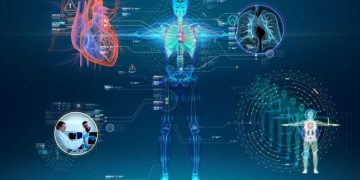
In healthcare, the application of self-supervised learning has the potential to revolutionize how AI models are trained for medical image analysis. Traditional supervised models require large labeled datasets of medical images, which are both scarce and expensive to obtain. Self-supervised models can learn representations of medical images without needing manual annotations, thus reducing the dependency on expert involvement.
- Self-Supervised Representation Learning in Medical Imaging: Researchers have developed self-supervised methods for learning image features in tasks like detecting tumors or classifying diseases in medical scans. By using unlabeled datasets of medical images, AI models can learn to detect important features and patterns in images, which can then be used for diagnostic purposes.

4. Benefits of Self-Supervised Learning
4.1 Cost-Effectiveness
The ability to train models on unlabeled data makes self-supervised learning much more cost-effective compared to traditional supervised learning methods. This allows companies and organizations to scale their AI solutions without the high costs associated with data annotation.
4.2 Scalability
Self-supervised learning enables AI models to be trained on vast amounts of unstructured data that are readily available. As more data becomes accessible across industries, self-supervised learning allows AI systems to scale rapidly and learn from diverse, expansive datasets.
4.3 Flexibility Across Domains
Since self-supervised learning methods do not require labeled data, they are applicable to a wide range of domains and industries, from finance to healthcare and autonomous vehicles. This adaptability makes SSL a powerful tool for industries where labeled data is limited or hard to come by.
5. Challenges and Limitations
Despite its promising potential, self-supervised learning does come with its own set of challenges:
5.1 Data Quality
While SSL reduces the need for labeled data, it still relies on high-quality unlabeled data to generate meaningful representations. Poor-quality data can lead to the learning of incorrect or irrelevant features, which may hinder the model’s performance in downstream tasks.
5.2 Model Complexity
Self-supervised learning models can be more complex to design and tune compared to traditional supervised learning models. The process of generating pseudo-labels or predicting data parts requires careful consideration of how to construct the learning task.
Conclusion
Self-supervised learning is revolutionizing AI model training by reducing the dependency on costly manually labeled data. By leveraging large amounts of unlabeled data, AI models can be trained more efficiently and effectively, leading to cost reductions and greater scalability across various industries. With applications ranging from NLP and computer vision to speech processing and medical imaging, self-supervised learning is unlocking new possibilities for AI development.
Despite its challenges, the future of self-supervised learning holds great promise, and as the field evolves, it will likely become a core technique for AI innovation in the years to come.