





















AIInsiderUpdates
  • Home
  • AI News
    Application of AI in Drug Therapy

    Application of AI in Drug Therapy

    The Popularization of AI: Automation of Traditional Jobs and Its Impact on the Labor Market

    The Popularization of AI: Automation of Traditional Jobs and Its Impact on the Labor Market

    Many Industries Are Adopting AI-Driven Robots to Replace Human Labor

    Many Industries Are Adopting AI-Driven Robots to Replace Human Labor

    Artificial Intelligence Ethics and Regulations

    Artificial Intelligence Ethics and Regulations

    Ensuring Fairness and Transparency in AI Decision-Making: A Priority for Companies and Governments

    Ensuring Fairness and Transparency in AI Decision-Making: A Priority for Companies and Governments

    The Growing Global Debate on AI Ethics and Governance

    The Growing Global Debate on AI Ethics and Governance

  • Technology Trends
    Fine-tuning Large Language Models to Meet Specific Task or Industry Needs: A Key Focus in AI Research

    Fine-tuning Large Language Models to Meet Specific Task or Industry Needs: A Key Focus in AI Research

    The Convergence of Reinforcement Learning and Deep Learning: Driving Innovation Across Multiple Domains

    The Convergence of Reinforcement Learning and Deep Learning: Driving Innovation Across Multiple Domains

    The Transformer Architecture: The Core of Deep Learning

    The Transformer Architecture: The Core of Deep Learning

    Neural Architecture Search: A Revolution in Artificial Intelligence

    Neural Architecture Search: A Revolution in Artificial Intelligence

    Significant Advances in Self-Supervised Learning (SSL) Methods in Deep Learning

    Significant Advances in Self-Supervised Learning (SSL) Methods in Deep Learning

    Breakthroughs in Deep Learning and Neural Networks: Revolutionizing the Future of AI

    Breakthroughs in Deep Learning and Neural Networks: Revolutionizing the Future of AI

  • Interviews & Opinions
    AI May Replace Some Low-Skill, Repetitive Jobs, but It Will Also Create New Types of Jobs

    AI May Replace Some Low-Skill, Repetitive Jobs, but It Will Also Create New Types of Jobs

    The Future of AI Systems: Why Explainability Should Be a Core Feature

    The Future of AI Systems: Why Explainability Should Be a Core Feature

    AI and Automation Will Take on More of the Heavy Lifting

    AI and Automation Will Take on More of the Heavy Lifting

    As AI Technology Continues to Evolve, Ethical Issues Are Becoming More Prominent

    As AI Technology Continues to Evolve, Ethical Issues Are Becoming More Prominent

    AI Fairness: Addressing Bias and Promoting Equity in Artificial Intelligence

    AI Fairness: Addressing Bias and Promoting Equity in Artificial Intelligence

    The Impact of AI on the Labor Market: A Critical Examination

    The Impact of AI on the Labor Market: A Critical Examination

  • Case Studies
    AI-Based Anti-Fraud Systems

    AI-Based Anti-Fraud Systems

    The Application of AI in Retail and E-Commerce

    The Application of AI in Retail and E-Commerce

    The Application of AI in the Financial Industry

    The Application of AI in the Financial Industry

    The Application of AI in Medical Imaging: A Significant Advancement

    The Application of AI in Medical Imaging: A Significant Advancement

    AI Significantly Enhancing Disease Diagnosis Efficiency and Accuracy

    AI Significantly Enhancing Disease Diagnosis Efficiency and Accuracy

    The Application of AI in Healthcare: Revolutionizing Medicine and Patient Care

    The Application of AI in Healthcare: Revolutionizing Medicine and Patient Care

  • Tools & Resources
    AI Learning Resources and Educational Platforms

    AI Learning Resources and Educational Platforms

    AI Automation and Model Training Tools: Revolutionizing the Future of Artificial Intelligence

    AI Automation and Model Training Tools: Revolutionizing the Future of Artificial Intelligence

    Keras: Making AI Development Easier While Supporting Complex Model Designs

    Keras: Making AI Development Easier While Supporting Complex Model Designs

    PyTorch: A Flexible and Debug-Friendly Deep Learning Framework

    PyTorch: A Flexible and Debug-Friendly Deep Learning Framework

    AutoAI Tools Enable Developers to Reduce Manual Model Tuning Workload

    AutoAI Tools Enable Developers to Reduce Manual Model Tuning Workload

    AI Development Platforms and Frameworks

    AI Development Platforms and Frameworks

AIInsiderUpdates
  • Home
  • AI News
    Application of AI in Drug Therapy

    Application of AI in Drug Therapy

    The Popularization of AI: Automation of Traditional Jobs and Its Impact on the Labor Market

    The Popularization of AI: Automation of Traditional Jobs and Its Impact on the Labor Market

    Many Industries Are Adopting AI-Driven Robots to Replace Human Labor

    Many Industries Are Adopting AI-Driven Robots to Replace Human Labor

    Artificial Intelligence Ethics and Regulations

    Artificial Intelligence Ethics and Regulations

    Ensuring Fairness and Transparency in AI Decision-Making: A Priority for Companies and Governments

    Ensuring Fairness and Transparency in AI Decision-Making: A Priority for Companies and Governments

    The Growing Global Debate on AI Ethics and Governance

    The Growing Global Debate on AI Ethics and Governance

  • Technology Trends
    Fine-tuning Large Language Models to Meet Specific Task or Industry Needs: A Key Focus in AI Research

    Fine-tuning Large Language Models to Meet Specific Task or Industry Needs: A Key Focus in AI Research

    The Convergence of Reinforcement Learning and Deep Learning: Driving Innovation Across Multiple Domains

    The Convergence of Reinforcement Learning and Deep Learning: Driving Innovation Across Multiple Domains

    The Transformer Architecture: The Core of Deep Learning

    The Transformer Architecture: The Core of Deep Learning

    Neural Architecture Search: A Revolution in Artificial Intelligence

    Neural Architecture Search: A Revolution in Artificial Intelligence

    Significant Advances in Self-Supervised Learning (SSL) Methods in Deep Learning

    Significant Advances in Self-Supervised Learning (SSL) Methods in Deep Learning

    Breakthroughs in Deep Learning and Neural Networks: Revolutionizing the Future of AI

    Breakthroughs in Deep Learning and Neural Networks: Revolutionizing the Future of AI

  • Interviews & Opinions
    AI May Replace Some Low-Skill, Repetitive Jobs, but It Will Also Create New Types of Jobs

    AI May Replace Some Low-Skill, Repetitive Jobs, but It Will Also Create New Types of Jobs

    The Future of AI Systems: Why Explainability Should Be a Core Feature

    The Future of AI Systems: Why Explainability Should Be a Core Feature

    AI and Automation Will Take on More of the Heavy Lifting

    AI and Automation Will Take on More of the Heavy Lifting

    As AI Technology Continues to Evolve, Ethical Issues Are Becoming More Prominent

    As AI Technology Continues to Evolve, Ethical Issues Are Becoming More Prominent

    AI Fairness: Addressing Bias and Promoting Equity in Artificial Intelligence

    AI Fairness: Addressing Bias and Promoting Equity in Artificial Intelligence

    The Impact of AI on the Labor Market: A Critical Examination

    The Impact of AI on the Labor Market: A Critical Examination

  • Case Studies
    AI-Based Anti-Fraud Systems

    AI-Based Anti-Fraud Systems

    The Application of AI in Retail and E-Commerce

    The Application of AI in Retail and E-Commerce

    The Application of AI in the Financial Industry

    The Application of AI in the Financial Industry

    The Application of AI in Medical Imaging: A Significant Advancement

    The Application of AI in Medical Imaging: A Significant Advancement

    AI Significantly Enhancing Disease Diagnosis Efficiency and Accuracy

    AI Significantly Enhancing Disease Diagnosis Efficiency and Accuracy

    The Application of AI in Healthcare: Revolutionizing Medicine and Patient Care

    The Application of AI in Healthcare: Revolutionizing Medicine and Patient Care

  • Tools & Resources
    AI Learning Resources and Educational Platforms

    AI Learning Resources and Educational Platforms

    AI Automation and Model Training Tools: Revolutionizing the Future of Artificial Intelligence

    AI Automation and Model Training Tools: Revolutionizing the Future of Artificial Intelligence

    Keras: Making AI Development Easier While Supporting Complex Model Designs

    Keras: Making AI Development Easier While Supporting Complex Model Designs

    PyTorch: A Flexible and Debug-Friendly Deep Learning Framework

    PyTorch: A Flexible and Debug-Friendly Deep Learning Framework

    AutoAI Tools Enable Developers to Reduce Manual Model Tuning Workload

    AutoAI Tools Enable Developers to Reduce Manual Model Tuning Workload

    AI Development Platforms and Frameworks

    AI Development Platforms and Frameworks

AIInsiderUpdates
No Result
View All Result

Advancements in Quantum Computing and Their Impact on AI Development

February 22, 2025
Advancements in Quantum Computing and Their Impact on AI Development

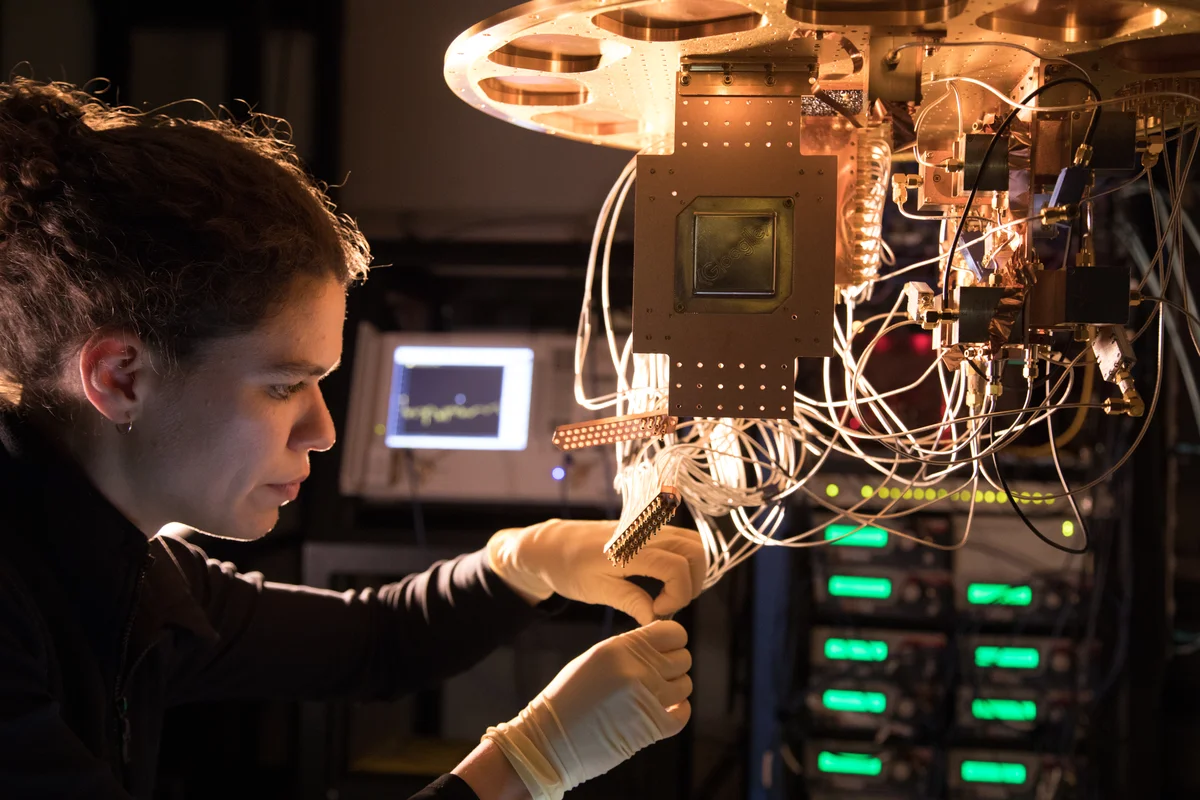
Quantum computing is a rapidly evolving field that promises to revolutionize industries ranging from cryptography to healthcare, and one of its most exciting applications is in the realm of artificial intelligence (AI). As AI algorithms become increasingly complex and demand higher computational power, quantum computing offers a new paradigm for solving problems that are currently intractable for classical computers. In this article, we will explore how quantum computing is poised to revolutionize AI algorithms and processing capabilities, examine the synergies between quantum computing and machine learning, and highlight the potential future advancements in the field.

1. Introduction to Quantum Computing

Quantum computing represents a fundamental shift in how computation is performed. Unlike classical computers, which process information in binary units (bits), quantum computers use quantum bits or qubits. Qubits can exist in multiple states simultaneously, thanks to a phenomenon known as superposition. This allows quantum computers to process vast amounts of information in parallel, enabling them to solve problems much more efficiently than classical computers.

Quantum computers also leverage another quantum principle called entanglement, where qubits become interdependent, allowing for the instant transfer of information across vast distances. These two principles—superposition and entanglement—make quantum computing incredibly powerful for certain types of computations.

For AI, which often requires immense processing power, quantum computing offers the potential to drastically reduce the time needed to train machine learning models, solve optimization problems, and analyze large datasets.

2. The Synergy Between Quantum Computing and AI

While AI has made tremendous strides in recent years, much of its progress has been hindered by the limitations of classical computing. Tasks like processing massive datasets, running complex simulations, and training deep learning models require significant computational resources. Quantum computing offers a promising solution by providing the necessary computational power to handle these tasks more efficiently.

a) Quantum Machine Learning (QML)

Quantum machine learning (QML) is an emerging field that combines quantum computing with machine learning techniques. Quantum computers can process large datasets much faster than classical computers, making it possible to train more complex machine learning models in less time. Quantum algorithms, such as the quantum version of the k-means clustering algorithm or quantum neural networks, have the potential to solve problems in areas like pattern recognition, image processing, and natural language processing more efficiently than traditional algorithms.

QML could help accelerate the development of AI systems by enabling faster training times, more accurate models, and the ability to tackle problems that are currently beyond the reach of classical computers. For example, quantum computers can exponentially speed up the optimization of machine learning models, allowing AI systems to make better predictions or decisions faster.

b) Quantum Optimization Algorithms

Optimization problems are central to AI and machine learning, especially in tasks like training models, scheduling, or resource allocation. Quantum computing offers new methods for solving optimization problems more efficiently than classical algorithms. Quantum algorithms like the Quantum Approximate Optimization Algorithm (QAOA) and Grover’s algorithm have been proposed to improve optimization tasks by searching through large solution spaces more effectively.

In machine learning, optimization is used to adjust model parameters in order to minimize error and improve accuracy. Quantum optimization algorithms could significantly reduce the time and computational resources required for these tasks, leading to faster and more efficient AI models.

3. Enhancing AI Algorithms with Quantum Computing

Quantum computing has the potential to enhance AI algorithms in several ways, improving both their speed and capabilities.

a) Accelerating Deep Learning

Deep learning, a subfield of machine learning, relies on neural networks with many layers to model complex relationships in data. Training deep learning models often requires massive amounts of data and computational resources. Classical computers can struggle to keep up with the demands of training deep learning models, especially when the models become large and complex.

Quantum computing can accelerate deep learning by leveraging quantum parallelism, enabling quantum computers to process large datasets and learn complex patterns faster. Quantum neural networks, which are designed to operate on quantum computers, could help achieve better performance with fewer resources. These advancements could lead to the development of AI systems that can perform tasks like image recognition, natural language processing, and speech recognition more accurately and efficiently.

b) Improving Reinforcement Learning

Reinforcement learning (RL) is a type of machine learning in which an agent learns to make decisions by interacting with an environment and receiving feedback in the form of rewards or penalties. RL is widely used in applications like robotics, game playing, and autonomous vehicles. However, training RL agents can be computationally expensive, as it requires running many simulations to learn optimal behaviors.

Quantum computing could potentially speed up reinforcement learning by providing more efficient ways to explore the state space and improve the learning process. Quantum-enhanced RL algorithms could help AI agents learn more quickly, with fewer resources, and solve problems that would be difficult for classical computers to handle.

c) Quantum Data Processing

In AI, data preprocessing is a crucial step for preparing raw data for machine learning algorithms. Classical data processing methods can be time-consuming and computationally expensive, particularly for large datasets. Quantum computers, with their ability to process large volumes of data in parallel, could significantly speed up this process.

Quantum-enhanced data processing could improve feature extraction, dimensionality reduction, and data encoding, enabling AI models to handle more complex datasets. Quantum algorithms could also help solve data-related challenges, such as finding patterns in noisy data or optimizing data storage.

4. Challenges in Integrating Quantum Computing with AI

While quantum computing holds immense promise for AI, there are still several challenges to overcome before it can be fully integrated into AI applications.

a) Hardware Limitations

Quantum computers are still in the early stages of development, and current quantum hardware is limited in terms of qubit count, coherence time, and error rates. These limitations make it difficult to build large-scale quantum computers that can solve real-world AI problems. Researchers are actively working on improving quantum hardware, but it may take several years before quantum computers are ready for widespread use in AI.

b) Algorithmic Challenges

While quantum algorithms hold promise, developing efficient quantum machine learning algorithms is still a work in progress. Many quantum machine learning algorithms are still in their theoretical stages, and more research is needed to identify which algorithms will be most effective for AI tasks. Additionally, classical algorithms will still play a significant role in AI development for the foreseeable future, so finding ways to combine classical and quantum approaches will be crucial for practical applications.

c) Scalability

For quantum computing to have a meaningful impact on AI, quantum systems must be scalable. This means that quantum computers need to be able to handle larger datasets, more complex algorithms, and more qubits. Currently, most quantum computers have only a small number of qubits, which limits their ability to process large-scale AI problems. However, advancements in quantum error correction and hardware development are paving the way for more scalable quantum systems.

5. The Future of Quantum Computing and AI

The intersection of quantum computing and AI is still in its infancy, but the potential for future breakthroughs is enormous. As quantum hardware improves and quantum algorithms mature, we can expect significant advancements in AI applications. Some of the key areas where quantum computing could make a major impact include:

  • Personalized Medicine: Quantum-enhanced AI could help accelerate drug discovery, analyze genetic data, and develop personalized treatment plans more efficiently.
  • Autonomous Vehicles: Quantum-powered AI could improve the decision-making processes of autonomous vehicles, making them safer and more efficient.
  • Climate Change Modeling: Quantum computers could help model complex climate systems, enabling AI to make more accurate predictions and recommendations for mitigating climate change.

In the coming years, we may see quantum computing become a mainstream tool for AI research and development, unlocking new possibilities and accelerating progress in fields such as healthcare, finance, robotics, and beyond.

Conclusion

Quantum computing has the potential to revolutionize AI by providing the computational power needed to solve problems that are currently beyond the capabilities of classical computers. By enabling faster machine learning model training, enhancing data processing, and improving optimization tasks, quantum computing will accelerate the development of more powerful and efficient AI systems. While challenges remain, the future of quantum computing and AI is bright, with the potential to transform industries and drive innovation in ways we can only begin to imagine.


Tags: AI and Quantum Computingmachine learningquantum computing
ShareTweetShare

Related Posts

Fine-tuning Large Language Models to Meet Specific Task or Industry Needs: A Key Focus in AI Research
Technology Trends

Fine-tuning Large Language Models to Meet Specific Task or Industry Needs: A Key Focus in AI Research

April 28, 2026
The Convergence of Reinforcement Learning and Deep Learning: Driving Innovation Across Multiple Domains
Technology Trends

The Convergence of Reinforcement Learning and Deep Learning: Driving Innovation Across Multiple Domains

April 28, 2026
Application of AI in Drug Therapy
AI News

Application of AI in Drug Therapy

April 28, 2026
The Popularization of AI: Automation of Traditional Jobs and Its Impact on the Labor Market
AI News

The Popularization of AI: Automation of Traditional Jobs and Its Impact on the Labor Market

April 28, 2026
The Transformer Architecture: The Core of Deep Learning
Technology Trends

The Transformer Architecture: The Core of Deep Learning

April 21, 2026
Neural Architecture Search: A Revolution in Artificial Intelligence
Technology Trends

Neural Architecture Search: A Revolution in Artificial Intelligence

April 21, 2026
Leave Comment
  • Trending
  • Comments
  • Latest
How Artificial Intelligence is Achieving Revolutionary Breakthroughs in the Healthcare Industry: What Success Stories Teach Us

How Artificial Intelligence is Achieving Revolutionary Breakthroughs in the Healthcare Industry: What Success Stories Teach Us

July 26, 2025
Deep Learning Simulates Human Brain Signal Processing Pathways Through the Construction of Multi-Layer Neural Networks

Deep Learning Simulates Human Brain Signal Processing Pathways Through the Construction of Multi-Layer Neural Networks

January 14, 2026
From Beginner to Expert: Which AI Platforms Are Best for Beginners? Experts’ Take on Learning Curves and Practical Applications

From Beginner to Expert: Which AI Platforms Are Best for Beginners? Experts’ Take on Learning Curves and Practical Applications

July 23, 2025
AI in the Financial Sector: Which Innovative Strategies Are Driving Digital Transformation?

AI in the Financial Sector: Which Innovative Strategies Are Driving Digital Transformation?

July 26, 2025
How Artificial Intelligence Enhances Diagnostic Accuracy and Transforms Treatment Methods in Healthcare

How Artificial Intelligence Enhances Diagnostic Accuracy and Transforms Treatment Methods in Healthcare

How AI Enhances Customer Experience and Drives Sales Growth in Retail

How AI Enhances Customer Experience and Drives Sales Growth in Retail

How Artificial Intelligence Enables Precise Risk Assessment and Decision-Making

How Artificial Intelligence Enables Precise Risk Assessment and Decision-Making

How AI is Driving the Revolution in Smart Manufacturing and Production Efficiency

How AI is Driving the Revolution in Smart Manufacturing and Production Efficiency

AI Learning Resources and Educational Platforms

AI Learning Resources and Educational Platforms

April 28, 2026
AI Automation and Model Training Tools: Revolutionizing the Future of Artificial Intelligence

AI Automation and Model Training Tools: Revolutionizing the Future of Artificial Intelligence

April 28, 2026
AI-Based Anti-Fraud Systems

AI-Based Anti-Fraud Systems

April 28, 2026
The Application of AI in Retail and E-Commerce

The Application of AI in Retail and E-Commerce

April 28, 2026
AIInsiderUpdates

Our platform is dedicated to delivering comprehensive coverage of AI developments, featuring news, case studies, expert interviews, and valuable resources for professionals and enthusiasts alike.

© 2025 aiinsiderupdates.com. contacts:[email protected]

No Result
View All Result
  • Home
  • AI News
  • Technology Trends
  • Interviews & Opinions
  • Case Studies
  • Tools & Resources

© 2025 aiinsiderupdates.com. contacts:[email protected]

Welcome Back!

Login to your account below

Forgotten Password?

Retrieve your password

Please enter your username or email address to reset your password.

Log In