



























Abstract
Artificial Intelligence (AI) has become a transformative force in manufacturing, reshaping traditional industrial processes and redefining operational excellence. By integrating AI into production lines, supply chains, quality control, and predictive maintenance, manufacturing enterprises are realizing significant cost reductions, enhanced efficiency, and improved product quality. This article explores the implementation of AI across the manufacturing sector, highlighting the technologies, strategies, and best practices that underpin its success. It also examines the challenges of adopting AI in complex industrial environments and discusses future trends that will further optimize operations and competitiveness.
1. Introduction: The Rise of AI in Manufacturing
1.1 From Automation to Intelligent Manufacturing
Manufacturing has always been at the forefront of adopting technological innovations, from mechanization to assembly line automation. The introduction of AI represents the next evolution: moving from pre-programmed automation to intelligent, adaptive systems capable of learning from data, anticipating disruptions, and optimizing production in real-time.
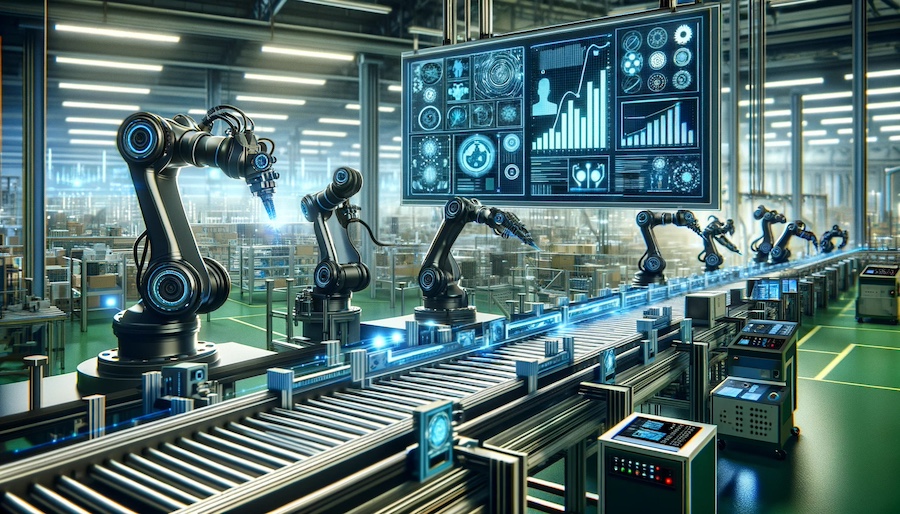
While traditional automation reduced labor costs and increased throughput, AI enhances operational efficiency by enabling predictive, adaptive, and decision-driven manufacturing processes. This shift has transformed factories into smart factories, where machines and systems communicate, analyze, and make decisions autonomously or in collaboration with human operators.
1.2 Economic Imperatives for AI Adoption
Global manufacturing faces increasing pressure from rising labor costs, supply chain disruptions, and demand for higher product quality. AI adoption addresses these challenges by:
- Minimizing waste through predictive analytics.
- Reducing downtime with AI-powered predictive maintenance.
- Optimizing production schedules and inventory management.
- Enhancing quality control through computer vision and anomaly detection.
The result is not just operational efficiency but also measurable cost savings and competitive advantage in increasingly competitive markets.
2. AI Applications in Manufacturing
2.1 Predictive Maintenance
Predictive maintenance is one of the most widely implemented AI applications in manufacturing. Traditional maintenance relied on fixed schedules or reactive approaches, which often led to unnecessary downtime or unexpected failures.
How AI Improves Maintenance:
- Sensor Data Analysis: IoT sensors collect data on temperature, vibration, pressure, and other parameters. AI models analyze these patterns to detect anomalies indicating potential failure.
- Predictive Modeling: Machine learning algorithms forecast equipment failures before they occur, allowing for timely interventions.
- Cost Savings: By preventing unplanned downtime, manufacturers reduce repair costs and production losses. Studies indicate predictive maintenance can cut maintenance costs by 20–40% and reduce unplanned downtime by 30–50%.
Case Example:
Siemens uses AI-driven predictive maintenance in its factory equipment, achieving substantial reductions in downtime and maintenance costs while improving overall equipment efficiency (OEE).
2.2 Quality Control and Defect Detection
Quality control has traditionally relied on human inspectors or simple automated systems. AI enhances this process through computer vision and deep learning, enabling the detection of defects with higher accuracy and speed.
Key Techniques:
- Computer Vision: Cameras capture images of products, and AI models identify defects such as scratches, misalignments, or color inconsistencies.
- Deep Learning Models: Convolutional neural networks (CNNs) learn from labeled defect datasets to detect even subtle anomalies.
- Real-Time Feedback: AI systems can immediately alert operators or adjust machines to correct defects, reducing scrap rates and improving product consistency.
Industry Impact:
Companies like BMW and Foxconn have integrated AI vision systems into assembly lines, achieving defect detection rates exceeding human accuracy and reducing defective product rates significantly.
2.3 Production Optimization and Scheduling
AI enables manufacturers to optimize production schedules dynamically, balancing machine availability, workforce capacity, and order priorities.
Techniques in Production Optimization:
- Machine Learning Forecasting: Predict demand patterns to align production schedules with market requirements.
- Constraint-Based Scheduling: AI algorithms optimize sequencing of operations while considering machine capabilities and deadlines.
- Digital Twins: Virtual replicas of factories simulate production scenarios, allowing AI to recommend the most efficient workflow configurations.
Benefits:
- Increased throughput and reduced cycle times.
- Better utilization of machines and workforce.
- Reduction in inventory holding costs.
2.4 Supply Chain and Inventory Management
AI extends beyond the factory floor into the supply chain, improving forecasting, procurement, and logistics:
- Demand Forecasting: Machine learning models predict demand fluctuations based on historical sales, seasonal trends, and market signals.
- Inventory Optimization: AI recommends optimal stock levels, reducing excess inventory and minimizing stockouts.
- Supplier Risk Management: AI analyzes supplier performance and identifies potential disruptions, enabling proactive interventions.
This integration results in cost reductions, improved delivery reliability, and better responsiveness to market changes.
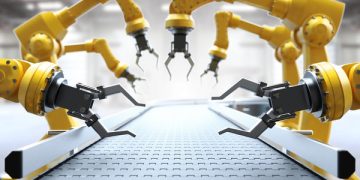
2.5 Robotics and Collaborative AI Systems
AI-powered industrial robots and collaborative robots (cobots) enhance efficiency by automating repetitive, hazardous, or precise tasks:
- Robotics Integration: Robots execute tasks such as welding, assembly, and material handling with AI-driven precision.
- Collaborative Systems: Cobots work alongside human operators, learning from interactions and adapting to workflow changes.
- Operational Impact: This integration improves speed, reduces errors, and ensures worker safety while maintaining flexibility for custom production runs.

3. Quantifying the Impact of AI on Cost and Efficiency
3.1 Cost Savings
AI implementation in manufacturing drives cost reduction in multiple dimensions:
- Maintenance Costs: Predictive maintenance reduces emergency repairs and extends equipment lifespan.
- Energy Consumption: AI models optimize energy use by adjusting machinery operation and production schedules.
- Waste Reduction: AI minimizes defective products and material scrap, leading to direct savings.
Companies adopting AI report cost reductions ranging from 15% to 40%, depending on the level of AI integration.
3.2 Efficiency Gains
Efficiency improvements are seen across production cycles:
- Cycle Time Reduction: AI optimizes machine sequencing and production planning, reducing cycle times.
- Throughput Increase: Smart scheduling and real-time adjustments increase production output.
- Workforce Productivity: AI automates repetitive tasks, allowing workers to focus on higher-value activities.
The combined effect is a measurable boost in overall equipment efficiency (OEE), translating into higher profitability.
3.3 Case Studies
3.3.1 Siemens Smart Factories
Siemens implemented AI-driven predictive maintenance and production optimization in its smart factories. Results included:
- 30% reduction in machine downtime.
- 25% increase in production efficiency.
- Significant reduction in maintenance and operational costs.
3.3.2 Foxconn AI Quality Control
Foxconn deployed AI vision systems for detecting defects in electronics assembly:
- Defect detection accuracy exceeded human inspection.
- Scrap rates decreased by 20%.
- Overall product quality improved, enhancing customer satisfaction.
3.3.3 General Electric (GE)
GE uses AI across its industrial machinery:
- Predictive analytics reduced unplanned maintenance events.
- Optimized energy consumption in factories, cutting operational costs.
- AI models improved the efficiency of turbine production lines.
4. Key Technologies Driving AI Success in Manufacturing
4.1 Internet of Things (IoT) and Sensor Integration
IoT devices collect real-time data on equipment, environment, and workflow. AI uses this data for predictive analytics, anomaly detection, and process optimization.
- Example: Vibration and temperature sensors on CNC machines feed AI models for predictive maintenance.
4.2 Machine Learning and Deep Learning
AI leverages supervised and unsupervised learning to detect patterns, predict outcomes, and optimize operations:
- Supervised Learning: Quality defect detection and demand forecasting.
- Unsupervised Learning: Anomaly detection and process optimization.
- Reinforcement Learning: Dynamic scheduling and robotics control.
4.3 Digital Twin Technology
Digital twins create virtual replicas of physical production systems:
- Simulate scenarios for process improvements.
- Predict outcomes of machine adjustments before implementation.
- Reduce experimentation costs and downtime.
4.4 Cloud Computing and Edge AI
- Cloud AI: Supports large-scale data analysis and model training.
- Edge AI: Enables real-time decisions at production sites without latency, essential for quality control and robotics.
5. Organizational and Operational Considerations
5.1 Workforce Readiness
Successful AI adoption requires upskilling employees to:
- Collaborate with AI systems.
- Interpret AI insights for operational decision-making.
- Maintain AI-powered machines and systems.
5.2 Change Management
Implementing AI requires cultural and structural changes:
- Transition from manual or reactive processes to data-driven operations.
- Promote cross-functional collaboration between IT, engineering, and operations.
- Foster an innovation mindset for continuous improvement.
5.3 Data Governance
Effective AI requires:
- High-quality, accurate, and timely data.
- Structured processes for data collection, storage, and access.
- Policies ensuring privacy, security, and compliance with regulations.
6. Challenges in AI Adoption
While AI offers significant benefits, challenges include:
- High Initial Investment: AI systems and IoT sensors require capital expenditure.
- Integration Complexity: Legacy equipment and processes may not be AI-compatible.
- Data Silos: Fragmented data across departments can hinder AI effectiveness.
- Scalability: Large-scale implementation requires robust infrastructure and expertise.
- Cybersecurity Risks: AI systems connected to IoT devices can be vulnerable to cyber threats.
7. Future Directions
7.1 Autonomous Factories
The future of AI in manufacturing points toward fully autonomous factories, where AI controls production, logistics, and maintenance with minimal human intervention.
7.2 AI-Enhanced Supply Chains
Integration of AI across suppliers and logistics networks will optimize end-to-end operations, reducing lead times and inventory costs.
7.3 AI-Driven Sustainability
AI will support sustainable manufacturing:
- Optimizing energy use and reducing emissions.
- Minimizing material waste.
- Designing products with lower environmental impact.
7.4 Generative AI in Manufacturing
Generative AI will contribute to:
- Product design optimization.
- Simulation of manufacturing scenarios.
- Predictive modeling for innovation and process improvement.
8. Conclusion
AI has emerged as a strategic enabler in manufacturing, delivering significant cost savings and efficiency gains. From predictive maintenance and quality control to production optimization and supply chain management, AI empowers manufacturers to operate smarter, faster, and more sustainably. Companies that successfully integrate AI into their operations realize measurable improvements in operational efficiency, reduced downtime, enhanced product quality, and competitive advantage. As AI technologies continue to evolve, their role in transforming manufacturing from conventional production to intelligent, adaptive, and autonomous systems will only grow, cementing AI as a core driver of industrial excellence.