

























AIInsiderUpdates
  • Home
  • AI News
    Global Regulatory Frameworks for AI: Progressing Towards Security, Ethics, Accountability, and Data Protection

    Global Regulatory Frameworks for AI: Progressing Towards Security, Ethics, Accountability, and Data Protection

    International Collaboration: A Key Driver for AI Technology Standards and Ecosystem Development

    International Collaboration: A Key Driver for AI Technology Standards and Ecosystem Development

    Industry-Leading AI Companies and Cloud Service Providers

    Industry-Leading AI Companies and Cloud Service Providers

    An Increasing Number of Enterprises Integrating AI into Core Strategy

    An Increasing Number of Enterprises Integrating AI into Core Strategy

    Large Model Providers and Enterprises in Speech & NLP Continue Expanding Application Scenarios

    Large Model Providers and Enterprises in Speech & NLP Continue Expanding Application Scenarios

    Breakthrough Advances in AI for Complex Perception and Reasoning Tasks

    Breakthrough Advances in AI for Complex Perception and Reasoning Tasks

  • Technology Trends
    AI Explainability and Ethics: Balancing Transparency, Accountability, and Trust in AI Systems

    AI Explainability and Ethics: Balancing Transparency, Accountability, and Trust in AI Systems

    Multimodal AI: Revolutionizing Data Integration and Understanding

    Multimodal AI: Revolutionizing Data Integration and Understanding

    Smart Manufacturing and Industrial AI

    Smart Manufacturing and Industrial AI

    Multilingual Understanding and Generation, Especially in Non-English Language Contexts: A Global Innovation Frontier

    Multilingual Understanding and Generation, Especially in Non-English Language Contexts: A Global Innovation Frontier

    AI Systems Are No Longer Limited to Single Inputs: The Rise of Multimodal AI

    AI Systems Are No Longer Limited to Single Inputs: The Rise of Multimodal AI

    Optimizing Transformer and Self-Attention Architectures to Enhance Model Expressiveness

    Optimizing Transformer and Self-Attention Architectures to Enhance Model Expressiveness

  • Interviews & Opinions
    Human-Machine Collaboration and Trend Prediction: The Future of Work and Decision-Making

    Human-Machine Collaboration and Trend Prediction: The Future of Work and Decision-Making

    Despite AI Automation Enhancements, Human Contribution Remains Unmatched in Data Creation and Cultural Context Understanding

    Despite AI Automation Enhancements, Human Contribution Remains Unmatched in Data Creation and Cultural Context Understanding

    Investment Bubbles and Risk Management: Diverging Perspectives

    Investment Bubbles and Risk Management: Diverging Perspectives

    CEO Perspectives on AI Data Contribution and the Role of Humans

    CEO Perspectives on AI Data Contribution and the Role of Humans

    Differences Between Academic and Public Perspectives on AI: Bridging the Gap

    Differences Between Academic and Public Perspectives on AI: Bridging the Gap

    AI Technology is No Longer Just a Tool: It Has Become a Core Component of Enterprise Competitiveness

    AI Technology is No Longer Just a Tool: It Has Become a Core Component of Enterprise Competitiveness

  • Case Studies
    Multidimensional Applications of AI in the Digital Transformation of Manufacturing

    Multidimensional Applications of AI in the Digital Transformation of Manufacturing

    AI Customer Service Bots and Smart Advisors: Helping Banks Reduce Human Customer Support Costs While Enhancing Response Efficiency, User Engagement, and Satisfaction

    AI Customer Service Bots and Smart Advisors: Helping Banks Reduce Human Customer Support Costs While Enhancing Response Efficiency, User Engagement, and Satisfaction

    Personalized Recommendation and Inventory Optimization

    Personalized Recommendation and Inventory Optimization

    How Retailers Use AI Models to Predict Sales Trends and Optimize Inventory Levels

    How Retailers Use AI Models to Predict Sales Trends and Optimize Inventory Levels

    AI Not Only Enhances Diagnostic Capabilities but Also Significantly Improves Backend Healthcare Services

    AI Not Only Enhances Diagnostic Capabilities but Also Significantly Improves Backend Healthcare Services

    AI in Manufacturing: Achieving Significant Cost Savings and Efficiency Improvements

    AI in Manufacturing: Achieving Significant Cost Savings and Efficiency Improvements

  • Tools & Resources
    Real-World Testing and Efficiency Evaluation of Emerging Technological Trends

    Real-World Testing and Efficiency Evaluation of Emerging Technological Trends

    Auxiliary AI Toolset: Enhancing Productivity, Innovation, and Problem Solving Across Industries

    Auxiliary AI Toolset: Enhancing Productivity, Innovation, and Problem Solving Across Industries

    Dataset Preprocessing and Labeling Strategies: A Resource Guide

    Dataset Preprocessing and Labeling Strategies: A Resource Guide

    Recommended Open Source Model Trade-Off Strategies

    Recommended Open Source Model Trade-Off Strategies

    Practical Roadmap: End-to-End Experience from Model Training to Deployment

    Practical Roadmap: End-to-End Experience from Model Training to Deployment

    Scalability and Performance Optimization: Insights and Best Practices

    Scalability and Performance Optimization: Insights and Best Practices

AIInsiderUpdates
  • Home
  • AI News
    Global Regulatory Frameworks for AI: Progressing Towards Security, Ethics, Accountability, and Data Protection

    Global Regulatory Frameworks for AI: Progressing Towards Security, Ethics, Accountability, and Data Protection

    International Collaboration: A Key Driver for AI Technology Standards and Ecosystem Development

    International Collaboration: A Key Driver for AI Technology Standards and Ecosystem Development

    Industry-Leading AI Companies and Cloud Service Providers

    Industry-Leading AI Companies and Cloud Service Providers

    An Increasing Number of Enterprises Integrating AI into Core Strategy

    An Increasing Number of Enterprises Integrating AI into Core Strategy

    Large Model Providers and Enterprises in Speech & NLP Continue Expanding Application Scenarios

    Large Model Providers and Enterprises in Speech & NLP Continue Expanding Application Scenarios

    Breakthrough Advances in AI for Complex Perception and Reasoning Tasks

    Breakthrough Advances in AI for Complex Perception and Reasoning Tasks

  • Technology Trends
    AI Explainability and Ethics: Balancing Transparency, Accountability, and Trust in AI Systems

    AI Explainability and Ethics: Balancing Transparency, Accountability, and Trust in AI Systems

    Multimodal AI: Revolutionizing Data Integration and Understanding

    Multimodal AI: Revolutionizing Data Integration and Understanding

    Smart Manufacturing and Industrial AI

    Smart Manufacturing and Industrial AI

    Multilingual Understanding and Generation, Especially in Non-English Language Contexts: A Global Innovation Frontier

    Multilingual Understanding and Generation, Especially in Non-English Language Contexts: A Global Innovation Frontier

    AI Systems Are No Longer Limited to Single Inputs: The Rise of Multimodal AI

    AI Systems Are No Longer Limited to Single Inputs: The Rise of Multimodal AI

    Optimizing Transformer and Self-Attention Architectures to Enhance Model Expressiveness

    Optimizing Transformer and Self-Attention Architectures to Enhance Model Expressiveness

  • Interviews & Opinions
    Human-Machine Collaboration and Trend Prediction: The Future of Work and Decision-Making

    Human-Machine Collaboration and Trend Prediction: The Future of Work and Decision-Making

    Despite AI Automation Enhancements, Human Contribution Remains Unmatched in Data Creation and Cultural Context Understanding

    Despite AI Automation Enhancements, Human Contribution Remains Unmatched in Data Creation and Cultural Context Understanding

    Investment Bubbles and Risk Management: Diverging Perspectives

    Investment Bubbles and Risk Management: Diverging Perspectives

    CEO Perspectives on AI Data Contribution and the Role of Humans

    CEO Perspectives on AI Data Contribution and the Role of Humans

    Differences Between Academic and Public Perspectives on AI: Bridging the Gap

    Differences Between Academic and Public Perspectives on AI: Bridging the Gap

    AI Technology is No Longer Just a Tool: It Has Become a Core Component of Enterprise Competitiveness

    AI Technology is No Longer Just a Tool: It Has Become a Core Component of Enterprise Competitiveness

  • Case Studies
    Multidimensional Applications of AI in the Digital Transformation of Manufacturing

    Multidimensional Applications of AI in the Digital Transformation of Manufacturing

    AI Customer Service Bots and Smart Advisors: Helping Banks Reduce Human Customer Support Costs While Enhancing Response Efficiency, User Engagement, and Satisfaction

    AI Customer Service Bots and Smart Advisors: Helping Banks Reduce Human Customer Support Costs While Enhancing Response Efficiency, User Engagement, and Satisfaction

    Personalized Recommendation and Inventory Optimization

    Personalized Recommendation and Inventory Optimization

    How Retailers Use AI Models to Predict Sales Trends and Optimize Inventory Levels

    How Retailers Use AI Models to Predict Sales Trends and Optimize Inventory Levels

    AI Not Only Enhances Diagnostic Capabilities but Also Significantly Improves Backend Healthcare Services

    AI Not Only Enhances Diagnostic Capabilities but Also Significantly Improves Backend Healthcare Services

    AI in Manufacturing: Achieving Significant Cost Savings and Efficiency Improvements

    AI in Manufacturing: Achieving Significant Cost Savings and Efficiency Improvements

  • Tools & Resources
    Real-World Testing and Efficiency Evaluation of Emerging Technological Trends

    Real-World Testing and Efficiency Evaluation of Emerging Technological Trends

    Auxiliary AI Toolset: Enhancing Productivity, Innovation, and Problem Solving Across Industries

    Auxiliary AI Toolset: Enhancing Productivity, Innovation, and Problem Solving Across Industries

    Dataset Preprocessing and Labeling Strategies: A Resource Guide

    Dataset Preprocessing and Labeling Strategies: A Resource Guide

    Recommended Open Source Model Trade-Off Strategies

    Recommended Open Source Model Trade-Off Strategies

    Practical Roadmap: End-to-End Experience from Model Training to Deployment

    Practical Roadmap: End-to-End Experience from Model Training to Deployment

    Scalability and Performance Optimization: Insights and Best Practices

    Scalability and Performance Optimization: Insights and Best Practices

AIInsiderUpdates
No Result
View All Result

The Intersection of AI and Robotics: Building Smarter Machines

February 20, 2025
The Intersection of AI and Robotics: Building Smarter Machines

The integration of artificial intelligence (AI) with robotics has led to a paradigm shift in various industries, from industrial automation to healthcare and agriculture. As AI continues to evolve, it enhances the capabilities of robots, enabling them to perform increasingly complex tasks autonomously. By combining AI’s learning algorithms and robotics’ mechanical capabilities, smarter machines are being built, capable of performing in real-world environments with greater efficiency, precision, and adaptability. However, this progression also raises several challenges, particularly in terms of ethics and autonomous decision-making. This article explores how AI is enhancing robotic capabilities, its applications in various sectors, the role of reinforcement learning in robotic decision-making, and the challenges of creating autonomous and ethical robots.

How AI is Enhancing Robotics Capabilities

AI is fundamentally transforming robotics by enabling robots to perform tasks that were previously unimaginable. Traditional robots, often limited to predefined, repetitive functions, are now being augmented with machine learning, computer vision, natural language processing, and other AI technologies. AI allows robots to learn from experience, adapt to new environments, and make intelligent decisions based on real-time data.

One of the primary ways AI enhances robotics is through machine learning (ML). ML algorithms enable robots to improve their performance over time by analyzing patterns and making predictions. For instance, robots used in manufacturing can continuously optimize their operations by learning from past production runs, identifying inefficiencies, and adapting to new tasks or changes in the environment. This shift from pre-programmed instructions to dynamic, adaptive learning opens up new possibilities for robots in industries like manufacturing, logistics, and service.

AI also plays a crucial role in enhancing robots’ sensory capabilities. With computer vision, robots can perceive their surroundings, detect objects, and interpret visual data. This ability is critical for tasks that require precision and dexterity, such as assembling delicate components or navigating cluttered environments. Robots equipped with AI-powered vision systems can recognize objects, identify hazards, and even interact with humans in a meaningful way.

Additionally, AI improves robotics in terms of natural language processing (NLP), enabling robots to understand and respond to human commands in natural language. This feature is especially important for robots used in customer service, healthcare, and home automation. With NLP, robots can interpret spoken commands, follow complex instructions, and even engage in basic conversations with users.

Applications in Industrial Automation, Healthcare, and Agriculture

AI-enhanced robots have found applications in a variety of sectors, where they perform tasks that are too dangerous, tedious, or complex for humans. The integration of AI in robotics is especially impactful in industrial automation, healthcare, and agriculture, where robots are making significant contributions to efficiency, safety, and productivity.

Industrial Automation

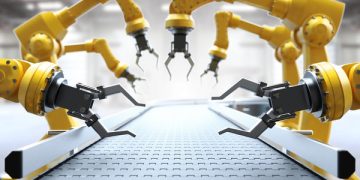
In industrial automation, robots equipped with AI technologies are revolutionizing the manufacturing process. AI-powered robots can work autonomously on production lines, performing tasks such as assembly, quality inspection, material handling, and packaging. These robots can also collaborate with human workers in a process known as collaborative robotics (cobots). Cobots are designed to work alongside humans, sharing tasks and ensuring that each worker can focus on higher-level functions while the robot handles repetitive or dangerous work.

AI enhances industrial robots by enabling them to learn from data collected during their operations. For example, predictive maintenance algorithms can predict when a robot or machine is likely to fail, allowing for proactive maintenance before a breakdown occurs. This reduces downtime, increases productivity, and cuts costs for manufacturers.

In addition, AI allows robots to optimize production processes by adjusting their actions based on real-time feedback. Robots can identify inefficiencies in the system, such as slow production rates or defects in products, and automatically adjust their operations to improve performance. This level of adaptability and optimization would be impossible with traditional robotic systems.

Healthcare

In healthcare, robots powered by AI are transforming the way medical procedures are performed, as well as how healthcare services are delivered. Surgical robots, for example, can perform complex surgeries with unparalleled precision, allowing for minimally invasive procedures that reduce recovery times and improve patient outcomes. These robots are equipped with AI algorithms that help surgeons plan and execute surgeries more effectively, offering real-time assistance and error-checking during the procedure.

AI-powered robots also play a vital role in patient care. Robots can assist with routine tasks such as administering medication, monitoring vital signs, and helping patients with mobility. Additionally, AI in healthcare robotics has made significant strides in areas like rehabilitation, where robots help patients regain motor function after injury or surgery. These robots use AI to assess a patient’s condition and adapt their exercises to suit the patient’s progress, ensuring personalized and effective rehabilitation.

Another notable application is the use of AI-powered robots in elderly care. Robots designed to assist older adults with daily activities such as dressing, eating, and walking can improve the quality of life for aging populations while reducing the burden on caregivers. AI allows these robots to understand and adapt to the specific needs of the elderly, providing support in a way that is both efficient and empathetic.

Agriculture

In agriculture, AI-powered robots are changing the way farming operations are carried out. Autonomous tractors, drones, and harvesters are now capable of performing tasks such as planting, spraying pesticides, and harvesting crops without human intervention. These robots use AI to analyze environmental data, such as soil quality and weather conditions, and make decisions on the optimal time to plant, water, or harvest crops.

AI-powered robots are also being used for precision agriculture, where they can monitor and manage crop growth at an individual plant level. These robots can identify pests, diseases, and nutrient deficiencies early on, enabling farmers to take targeted actions that minimize the use of chemicals and maximize crop yields. This approach not only improves productivity but also promotes sustainable farming practices by reducing the environmental impact of agriculture.

Advances in Reinforcement Learning for Robotic Decision-Making

Reinforcement learning (RL), a subfield of machine learning, is playing a pivotal role in enabling robots to make decisions autonomously in dynamic environments. Unlike supervised learning, where the model is trained on labeled data, RL allows robots to learn from trial and error, receiving feedback in the form of rewards or penalties based on their actions. This approach is particularly useful in robotics, where robots must make real-time decisions based on incomplete or uncertain information.

In reinforcement learning, an agent (the robot) interacts with an environment and learns to maximize a cumulative reward over time. For instance, a robot tasked with navigating an unfamiliar space might receive positive feedback when it takes an efficient path and negative feedback when it collides with obstacles. Over time, the robot learns the optimal strategies for navigating the environment and can adapt to changing conditions.

RL has been particularly effective in areas such as robotic manipulation, where robots learn to handle and manipulate objects. For example, a robot learning to stack boxes will receive rewards for successfully stacking them without toppling over. The robot continually refines its actions based on the feedback it receives, eventually learning to stack boxes with increasing precision.

In addition, RL is being used to train robots for complex tasks such as autonomous driving and drone flight. In these applications, the robots must make split-second decisions based on sensor data, including visual, auditory, and spatial information. By leveraging RL, robots can learn to navigate dynamic and unpredictable environments with a high degree of autonomy and safety.

Challenges in Creating Autonomous and Ethical Robots

Despite the tremendous progress made in AI and robotics, there are several challenges that need to be addressed before robots can fully operate autonomously in society. These challenges include technical hurdles, such as ensuring reliable and safe decision-making, and ethical concerns related to the autonomy of robots and their impact on society.

Technical Challenges

One of the biggest technical challenges in creating autonomous robots is ensuring that they can operate safely in dynamic and unpredictable environments. For example, robots designed for autonomous driving or industrial automation must be able to handle a wide variety of scenarios, such as unexpected obstacles, changes in lighting conditions, or sensor malfunctions. Achieving this level of reliability requires extensive testing, advanced sensor technologies, and sophisticated AI algorithms that can handle uncertainty and make decisions in real time.

Additionally, robots need to be able to learn from their experiences without introducing bias or errors. In reinforcement learning, for example, the robot’s learning process must be carefully monitored to ensure that it doesn’t reinforce harmful or inefficient behaviors. Ensuring that robots are able to make ethical decisions in complex scenarios is a crucial step in creating truly autonomous machines.

Ethical Challenges

The development of autonomous robots raises important ethical questions. As robots become more capable, there is a growing concern about the potential loss of jobs in various sectors, especially in industries like manufacturing and transportation. While robots can increase productivity and reduce costs, they may also lead to unemployment or wage disparity for human workers. Balancing the economic benefits of robotics with the potential societal impact is a key challenge for policymakers and industry leaders.

Another ethical issue is the question of robot autonomy in decision-making. Should robots be granted the ability to make life-and-death decisions, such as in the case of autonomous vehicles or healthcare robots? If a robot is involved in an accident or makes a harmful decision, who is responsible? These questions raise important legal and moral considerations about the role of robots in society and the boundaries of their decision-making power.

Moreover, there is a concern about privacy and security when it comes to robots equipped with AI. Many robots, particularly those used in healthcare or home automation, collect sensitive data about users. Ensuring that this data is protected and used ethically is paramount to maintaining public trust in robotic systems.

Conclusion

The intersection of AI and robotics is driving the development of smarter machines capable of performing complex tasks autonomously. From industrial automation to healthcare and agriculture, AI-powered robots are improving efficiency, safety, and productivity across various sectors. Reinforcement learning is advancing robotic decision-making, allowing robots to adapt and optimize their performance over time. However, the creation of autonomous robots also presents significant challenges, particularly in terms of safety, reliability, and ethics. As AI and robotics continue to evolve, it is essential to address these challenges to ensure that robots can operate safely, ethically, and in ways that benefit society as a whole.


Tags: aiHealthcare RoboticsIndustrial AutomationRobotics
ShareTweetShare

Related Posts

AI Explainability and Ethics: Balancing Transparency, Accountability, and Trust in AI Systems
Technology Trends

AI Explainability and Ethics: Balancing Transparency, Accountability, and Trust in AI Systems

January 21, 2026
Global Regulatory Frameworks for AI: Progressing Towards Security, Ethics, Accountability, and Data Protection
AI News

Global Regulatory Frameworks for AI: Progressing Towards Security, Ethics, Accountability, and Data Protection

January 21, 2026
Multimodal AI: Revolutionizing Data Integration and Understanding
Technology Trends

Multimodal AI: Revolutionizing Data Integration and Understanding

January 20, 2026
International Collaboration: A Key Driver for AI Technology Standards and Ecosystem Development
AI News

International Collaboration: A Key Driver for AI Technology Standards and Ecosystem Development

January 20, 2026
Smart Manufacturing and Industrial AI
Technology Trends

Smart Manufacturing and Industrial AI

January 19, 2026
Industry-Leading AI Companies and Cloud Service Providers
AI News

Industry-Leading AI Companies and Cloud Service Providers

January 19, 2026
Leave Comment
  • Trending
  • Comments
  • Latest
How Artificial Intelligence is Achieving Revolutionary Breakthroughs in the Healthcare Industry: What Success Stories Teach Us

How Artificial Intelligence is Achieving Revolutionary Breakthroughs in the Healthcare Industry: What Success Stories Teach Us

July 26, 2025
AI in the Financial Sector: Which Innovative Strategies Are Driving Digital Transformation?

AI in the Financial Sector: Which Innovative Strategies Are Driving Digital Transformation?

July 26, 2025
From Beginner to Expert: Which AI Platforms Are Best for Beginners? Experts’ Take on Learning Curves and Practical Applications

From Beginner to Expert: Which AI Platforms Are Best for Beginners? Experts’ Take on Learning Curves and Practical Applications

July 23, 2025
How to Find Truly Useful AI Resources Among the Crowd? Experts Share How to Select Efficient and Innovative Tools!

How to Find Truly Useful AI Resources Among the Crowd? Experts Share How to Select Efficient and Innovative Tools!

July 23, 2025
How Artificial Intelligence Enhances Diagnostic Accuracy and Transforms Treatment Methods in Healthcare

How Artificial Intelligence Enhances Diagnostic Accuracy and Transforms Treatment Methods in Healthcare

How AI Enhances Customer Experience and Drives Sales Growth in Retail

How AI Enhances Customer Experience and Drives Sales Growth in Retail

How Artificial Intelligence Enables Precise Risk Assessment and Decision-Making

How Artificial Intelligence Enables Precise Risk Assessment and Decision-Making

How AI is Driving the Revolution in Smart Manufacturing and Production Efficiency

How AI is Driving the Revolution in Smart Manufacturing and Production Efficiency

Real-World Testing and Efficiency Evaluation of Emerging Technological Trends

Real-World Testing and Efficiency Evaluation of Emerging Technological Trends

January 21, 2026
Multidimensional Applications of AI in the Digital Transformation of Manufacturing

Multidimensional Applications of AI in the Digital Transformation of Manufacturing

January 21, 2026
Human-Machine Collaboration and Trend Prediction: The Future of Work and Decision-Making

Human-Machine Collaboration and Trend Prediction: The Future of Work and Decision-Making

January 21, 2026
AI Explainability and Ethics: Balancing Transparency, Accountability, and Trust in AI Systems

AI Explainability and Ethics: Balancing Transparency, Accountability, and Trust in AI Systems

January 21, 2026
AIInsiderUpdates

Our platform is dedicated to delivering comprehensive coverage of AI developments, featuring news, case studies, expert interviews, and valuable resources for professionals and enthusiasts alike.

© 2025 aiinsiderupdates.com. contacts:[email protected]

No Result
View All Result
  • Home
  • AI News
  • Technology Trends
  • Interviews & Opinions
  • Case Studies
  • Tools & Resources

© 2025 aiinsiderupdates.com. contacts:[email protected]

Welcome Back!

Login to your account below

Forgotten Password?

Retrieve your password

Please enter your username or email address to reset your password.

Log In