




























AIInsiderUpdates
  • Home
  • AI News
    Global Regulatory Frameworks for AI: Progressing Towards Security, Ethics, Accountability, and Data Protection

    Global Regulatory Frameworks for AI: Progressing Towards Security, Ethics, Accountability, and Data Protection

    International Collaboration: A Key Driver for AI Technology Standards and Ecosystem Development

    International Collaboration: A Key Driver for AI Technology Standards and Ecosystem Development

    Industry-Leading AI Companies and Cloud Service Providers

    Industry-Leading AI Companies and Cloud Service Providers

    An Increasing Number of Enterprises Integrating AI into Core Strategy

    An Increasing Number of Enterprises Integrating AI into Core Strategy

    Large Model Providers and Enterprises in Speech & NLP Continue Expanding Application Scenarios

    Large Model Providers and Enterprises in Speech & NLP Continue Expanding Application Scenarios

    Breakthrough Advances in AI for Complex Perception and Reasoning Tasks

    Breakthrough Advances in AI for Complex Perception and Reasoning Tasks

  • Technology Trends
    AI Explainability and Ethics: Balancing Transparency, Accountability, and Trust in AI Systems

    AI Explainability and Ethics: Balancing Transparency, Accountability, and Trust in AI Systems

    Multimodal AI: Revolutionizing Data Integration and Understanding

    Multimodal AI: Revolutionizing Data Integration and Understanding

    Smart Manufacturing and Industrial AI

    Smart Manufacturing and Industrial AI

    Multilingual Understanding and Generation, Especially in Non-English Language Contexts: A Global Innovation Frontier

    Multilingual Understanding and Generation, Especially in Non-English Language Contexts: A Global Innovation Frontier

    AI Systems Are No Longer Limited to Single Inputs: The Rise of Multimodal AI

    AI Systems Are No Longer Limited to Single Inputs: The Rise of Multimodal AI

    Optimizing Transformer and Self-Attention Architectures to Enhance Model Expressiveness

    Optimizing Transformer and Self-Attention Architectures to Enhance Model Expressiveness

  • Interviews & Opinions
    Human-Machine Collaboration and Trend Prediction: The Future of Work and Decision-Making

    Human-Machine Collaboration and Trend Prediction: The Future of Work and Decision-Making

    Despite AI Automation Enhancements, Human Contribution Remains Unmatched in Data Creation and Cultural Context Understanding

    Despite AI Automation Enhancements, Human Contribution Remains Unmatched in Data Creation and Cultural Context Understanding

    Investment Bubbles and Risk Management: Diverging Perspectives

    Investment Bubbles and Risk Management: Diverging Perspectives

    CEO Perspectives on AI Data Contribution and the Role of Humans

    CEO Perspectives on AI Data Contribution and the Role of Humans

    Differences Between Academic and Public Perspectives on AI: Bridging the Gap

    Differences Between Academic and Public Perspectives on AI: Bridging the Gap

    AI Technology is No Longer Just a Tool: It Has Become a Core Component of Enterprise Competitiveness

    AI Technology is No Longer Just a Tool: It Has Become a Core Component of Enterprise Competitiveness

  • Case Studies
    Multidimensional Applications of AI in the Digital Transformation of Manufacturing

    Multidimensional Applications of AI in the Digital Transformation of Manufacturing

    AI Customer Service Bots and Smart Advisors: Helping Banks Reduce Human Customer Support Costs While Enhancing Response Efficiency, User Engagement, and Satisfaction

    AI Customer Service Bots and Smart Advisors: Helping Banks Reduce Human Customer Support Costs While Enhancing Response Efficiency, User Engagement, and Satisfaction

    Personalized Recommendation and Inventory Optimization

    Personalized Recommendation and Inventory Optimization

    How Retailers Use AI Models to Predict Sales Trends and Optimize Inventory Levels

    How Retailers Use AI Models to Predict Sales Trends and Optimize Inventory Levels

    AI Not Only Enhances Diagnostic Capabilities but Also Significantly Improves Backend Healthcare Services

    AI Not Only Enhances Diagnostic Capabilities but Also Significantly Improves Backend Healthcare Services

    AI in Manufacturing: Achieving Significant Cost Savings and Efficiency Improvements

    AI in Manufacturing: Achieving Significant Cost Savings and Efficiency Improvements

  • Tools & Resources
    Real-World Testing and Efficiency Evaluation of Emerging Technological Trends

    Real-World Testing and Efficiency Evaluation of Emerging Technological Trends

    Auxiliary AI Toolset: Enhancing Productivity, Innovation, and Problem Solving Across Industries

    Auxiliary AI Toolset: Enhancing Productivity, Innovation, and Problem Solving Across Industries

    Dataset Preprocessing and Labeling Strategies: A Resource Guide

    Dataset Preprocessing and Labeling Strategies: A Resource Guide

    Recommended Open Source Model Trade-Off Strategies

    Recommended Open Source Model Trade-Off Strategies

    Practical Roadmap: End-to-End Experience from Model Training to Deployment

    Practical Roadmap: End-to-End Experience from Model Training to Deployment

    Scalability and Performance Optimization: Insights and Best Practices

    Scalability and Performance Optimization: Insights and Best Practices

AIInsiderUpdates
  • Home
  • AI News
    Global Regulatory Frameworks for AI: Progressing Towards Security, Ethics, Accountability, and Data Protection

    Global Regulatory Frameworks for AI: Progressing Towards Security, Ethics, Accountability, and Data Protection

    International Collaboration: A Key Driver for AI Technology Standards and Ecosystem Development

    International Collaboration: A Key Driver for AI Technology Standards and Ecosystem Development

    Industry-Leading AI Companies and Cloud Service Providers

    Industry-Leading AI Companies and Cloud Service Providers

    An Increasing Number of Enterprises Integrating AI into Core Strategy

    An Increasing Number of Enterprises Integrating AI into Core Strategy

    Large Model Providers and Enterprises in Speech & NLP Continue Expanding Application Scenarios

    Large Model Providers and Enterprises in Speech & NLP Continue Expanding Application Scenarios

    Breakthrough Advances in AI for Complex Perception and Reasoning Tasks

    Breakthrough Advances in AI for Complex Perception and Reasoning Tasks

  • Technology Trends
    AI Explainability and Ethics: Balancing Transparency, Accountability, and Trust in AI Systems

    AI Explainability and Ethics: Balancing Transparency, Accountability, and Trust in AI Systems

    Multimodal AI: Revolutionizing Data Integration and Understanding

    Multimodal AI: Revolutionizing Data Integration and Understanding

    Smart Manufacturing and Industrial AI

    Smart Manufacturing and Industrial AI

    Multilingual Understanding and Generation, Especially in Non-English Language Contexts: A Global Innovation Frontier

    Multilingual Understanding and Generation, Especially in Non-English Language Contexts: A Global Innovation Frontier

    AI Systems Are No Longer Limited to Single Inputs: The Rise of Multimodal AI

    AI Systems Are No Longer Limited to Single Inputs: The Rise of Multimodal AI

    Optimizing Transformer and Self-Attention Architectures to Enhance Model Expressiveness

    Optimizing Transformer and Self-Attention Architectures to Enhance Model Expressiveness

  • Interviews & Opinions
    Human-Machine Collaboration and Trend Prediction: The Future of Work and Decision-Making

    Human-Machine Collaboration and Trend Prediction: The Future of Work and Decision-Making

    Despite AI Automation Enhancements, Human Contribution Remains Unmatched in Data Creation and Cultural Context Understanding

    Despite AI Automation Enhancements, Human Contribution Remains Unmatched in Data Creation and Cultural Context Understanding

    Investment Bubbles and Risk Management: Diverging Perspectives

    Investment Bubbles and Risk Management: Diverging Perspectives

    CEO Perspectives on AI Data Contribution and the Role of Humans

    CEO Perspectives on AI Data Contribution and the Role of Humans

    Differences Between Academic and Public Perspectives on AI: Bridging the Gap

    Differences Between Academic and Public Perspectives on AI: Bridging the Gap

    AI Technology is No Longer Just a Tool: It Has Become a Core Component of Enterprise Competitiveness

    AI Technology is No Longer Just a Tool: It Has Become a Core Component of Enterprise Competitiveness

  • Case Studies
    Multidimensional Applications of AI in the Digital Transformation of Manufacturing

    Multidimensional Applications of AI in the Digital Transformation of Manufacturing

    AI Customer Service Bots and Smart Advisors: Helping Banks Reduce Human Customer Support Costs While Enhancing Response Efficiency, User Engagement, and Satisfaction

    AI Customer Service Bots and Smart Advisors: Helping Banks Reduce Human Customer Support Costs While Enhancing Response Efficiency, User Engagement, and Satisfaction

    Personalized Recommendation and Inventory Optimization

    Personalized Recommendation and Inventory Optimization

    How Retailers Use AI Models to Predict Sales Trends and Optimize Inventory Levels

    How Retailers Use AI Models to Predict Sales Trends and Optimize Inventory Levels

    AI Not Only Enhances Diagnostic Capabilities but Also Significantly Improves Backend Healthcare Services

    AI Not Only Enhances Diagnostic Capabilities but Also Significantly Improves Backend Healthcare Services

    AI in Manufacturing: Achieving Significant Cost Savings and Efficiency Improvements

    AI in Manufacturing: Achieving Significant Cost Savings and Efficiency Improvements

  • Tools & Resources
    Real-World Testing and Efficiency Evaluation of Emerging Technological Trends

    Real-World Testing and Efficiency Evaluation of Emerging Technological Trends

    Auxiliary AI Toolset: Enhancing Productivity, Innovation, and Problem Solving Across Industries

    Auxiliary AI Toolset: Enhancing Productivity, Innovation, and Problem Solving Across Industries

    Dataset Preprocessing and Labeling Strategies: A Resource Guide

    Dataset Preprocessing and Labeling Strategies: A Resource Guide

    Recommended Open Source Model Trade-Off Strategies

    Recommended Open Source Model Trade-Off Strategies

    Practical Roadmap: End-to-End Experience from Model Training to Deployment

    Practical Roadmap: End-to-End Experience from Model Training to Deployment

    Scalability and Performance Optimization: Insights and Best Practices

    Scalability and Performance Optimization: Insights and Best Practices

AIInsiderUpdates
No Result
View All Result

The Fusion of Augmented Reality and Natural Language Processing

December 10, 2025
The Fusion of Augmented Reality and Natural Language Processing

Introduction

The convergence of Augmented Reality (AR) and Natural Language Processing (NLP) represents a groundbreaking frontier in human-computer interaction. These two technologies, each innovative in its own right, are merging to create immersive, context-aware environments that can respond to human language in natural and intuitive ways. Augmented Reality overlays digital information onto the real world, while Natural Language Processing enables machines to understand, interpret, and respond to human language. When combined, they offer unique opportunities for enhancing user experiences across a variety of industries, including healthcare, education, retail, and entertainment.

This fusion not only improves user engagement and accessibility but also opens up new possibilities for interaction and functionality. Imagine navigating a new city with real-time language translation or receiving personalized, voice-activated assistance while interacting with physical objects in the real world. The combination of AR and NLP has the potential to revolutionize how we interact with technology and our surroundings.

In this article, we explore the integration of Augmented Reality and Natural Language Processing, examining how these technologies are converging, the current use cases, and the future possibilities. We will also discuss the challenges that come with this fusion and how developers and organizations are working to overcome them.


1. Understanding Augmented Reality (AR) and Natural Language Processing (NLP)

1.1 What is Augmented Reality (AR)?

Augmented Reality (AR) is a technology that superimposes digital content—such as images, videos, sounds, and other sensory stimuli—onto the real-world environment. This integration enhances the user’s perception of the world by providing interactive, context-sensitive information in real-time.

AR can be experienced through a variety of devices, including smartphones, tablets, AR glasses (e.g., Microsoft HoloLens, Magic Leap), and heads-up displays in vehicles. AR systems generally rely on sensors, cameras, and software to recognize objects or environments and seamlessly blend digital content into the real-world view.

Key elements of AR include:

  • Real-Time Interaction: The ability to interact with digital objects as if they exist in the physical world.
  • Context-Aware: AR can adjust its content based on the user’s environment or actions.
  • Immersive Visuals: By overlaying visuals, text, or 3D models on the real world, AR creates immersive experiences.

1.2 What is Natural Language Processing (NLP)?

Natural Language Processing (NLP) is a branch of artificial intelligence (AI) that focuses on the interaction between computers and human languages. The goal of NLP is to enable machines to understand, interpret, and generate human language in a way that is both meaningful and contextually relevant.

NLP is used in many applications, such as:

  • Speech Recognition: Converting spoken language into text (e.g., Siri, Google Assistant).
  • Machine Translation: Translating text between languages (e.g., Google Translate).
  • Sentiment Analysis: Analyzing text to determine sentiment, emotion, or intent.
  • Text Generation: Generating human-like text based on prompts or context.

NLP works by breaking down human language into smaller, manageable pieces (tokens) and applying linguistic models to understand grammar, semantics, and context. Deep learning models, such as transformers and neural networks, have significantly improved NLP’s ability to process language in a way that mimics human understanding.


2. The Synergy Between AR and NLP

2.1 How AR and NLP Complement Each Other

The fusion of AR and NLP allows for a richer and more intuitive user experience by combining the immersive qualities of AR with the conversational power of NLP. This synergy makes it possible for users to interact with both the physical and digital worlds using natural language, thereby lowering the barriers between users and technology.

Here’s how AR and NLP complement each other:

  • Context-Aware Conversations: AR allows the user to see the world around them with digital overlays, while NLP enables the user to interact with those overlays via voice or text. For example, a user can speak to their AR headset and ask questions about the objects or places they see, and the NLP system will provide relevant answers or actions based on the context.
  • Hands-Free Interaction: By combining AR’s visual augmentation with NLP’s voice-based interactions, users can engage with digital content without needing to touch screens or buttons. This is particularly useful in situations where hands-free operation is critical, such as in healthcare, manufacturing, or field service.
  • Real-Time Translation: AR can superimpose text or images on a user’s environment, while NLP can be used to translate spoken language in real-time. This could be invaluable for travelers, business professionals, or language learners, as it allows them to understand foreign languages instantly through visual cues.
  • Personalized Assistance: With NLP’s ability to understand and process voice commands, AR systems can offer real-time, personalized guidance. For instance, AR applications could help users navigate complex environments, provide product information, or offer instructional support, all in response to natural language queries.

2.2 Key Technologies Driving the Fusion

The integration of AR and NLP relies on several technological advancements:

  • Voice Recognition and Speech-to-Text: NLP requires sophisticated speech recognition systems to understand spoken language. These systems convert speech into text that can be processed and interpreted by NLP algorithms. Popular frameworks like Google Speech-to-Text or Apple’s Siri use this technology to enable voice commands in AR systems.
  • Computer Vision: AR uses computer vision to identify and track physical objects in the environment. When combined with NLP, AR systems can recognize and respond to natural language commands related to objects in the user’s view. For instance, a user could ask an AR application to “show me the price of this item,” and the system would use computer vision to identify the object and NLP to provide the requested information.
  • Natural Language Understanding (NLU): NLU is a subfield of NLP that focuses on understanding the meaning of text. For AR applications, NLU allows the system to comprehend and act on user queries related to their physical environment, such as recognizing the user’s intent or context and generating relevant responses.
  • AI and Machine Learning: Machine learning algorithms are crucial for both AR and NLP, allowing systems to continually learn and adapt to user preferences, voice patterns, and contextual nuances. This enables more accurate interpretations of user commands and improves the system’s ability to generate appropriate responses.

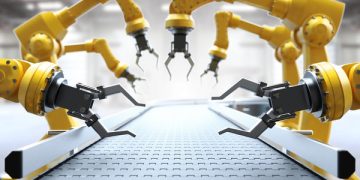
Boy programs and controls the robot on the street via augmented reality technology concept

3. Applications of AR and NLP Fusion

3.1 AR and NLP in Retail

The retail industry stands to benefit greatly from the fusion of AR and NLP. This combination can enhance the shopping experience by allowing customers to interact with products in a more personalized and immersive way.

  • Virtual Shopping Assistants: By using AR, customers can see how products (such as furniture, clothing, or cosmetics) would look in their own homes or on their bodies. NLP can enable users to ask questions about product features, availability, and pricing, while the AR system adjusts its display in real time based on the conversation.
  • Personalized Recommendations: AR and NLP can work together to provide real-time personalized product recommendations. For example, a customer could walk through a store, and an AR system could highlight items they may be interested in based on past purchases. They could then ask, “What size is this in my color?” and receive an instant response powered by NLP.
  • Language Translation for Global Shoppers: In a global marketplace, AR and NLP can offer real-time language translation for product labels, instructions, and advertisements. Shoppers could point their phone at a product and see translated information about it, making international shopping more accessible.

3.2 AR and NLP in Healthcare

In healthcare, the fusion of AR and NLP has the potential to transform both patient care and medical training.

  • Medical Assistance and Guidance: AR combined with NLP can provide hands-free, real-time assistance for healthcare providers. For example, a doctor could use AR glasses to view critical patient data overlaid onto the patient’s body during surgery, while using NLP to interact with the system verbally to retrieve specific information, such as lab results or medical history.
  • Patient Interaction: For patients, AR can be used to visualize their treatment plans or receive step-by-step instructions for post-operative care, while NLP allows them to ask questions and receive answers in real-time. Patients could also interact with virtual medical assistants for personalized advice and recommendations.

3.3 AR and NLP in Education

The combination of AR and NLP has the power to revolutionize how we learn by providing immersive and interactive educational experiences.

  • Interactive Learning: AR can turn a regular classroom into an interactive environment where students can explore 3D models, historical reconstructions, or scientific phenomena. NLP can be used to allow students to ask questions about the content or clarify complex concepts, creating a more engaging learning experience.
  • Language Learning: AR and NLP can be combined to create immersive language learning experiences. For example, AR can display translations of foreign language words in the user’s environment, while NLP can facilitate conversation practice through speech recognition and real-time feedback.

3.4 AR and NLP in Navigation and Tourism

For tourism and navigation, the integration of AR and NLP offers enhanced, hands-free experiences for travelers.

  • Smart Tourism Guides: By using AR glasses or smartphone apps, tourists can view augmented information about landmarks, restaurants, or cultural sites in real-time. NLP allows tourists to interact with the system, asking for directions or information about nearby points of interest in their native language.
  • Real-Time Translation: In unfamiliar locations, NLP can be used to provide real-time translations for spoken language, while AR overlays translated text or signs on the environment. This combination could break down language barriers for travelers, making their journeys more seamless and enjoyable.

4. Challenges and Considerations in AR and NLP Integration

While the potential of AR and NLP is immense, there are several challenges to overcome in their integration:

  • Accuracy and Context Understanding: Both AR and NLP systems need to be contextually aware in order to provide accurate responses. Understanding the user’s environment, intentions, and language nuances can be difficult, and errors in interpretation could lead to frustration or misunderstandings.
  • Hardware and Device Limitations: AR technologies, particularly those using glasses or headsets, require specialized hardware. The performance of these devices—such as processing power, battery life, and display quality—can limit the effectiveness of AR-NLP systems.
  • Data Privacy and Security: AR and NLP systems often require access to sensitive user data, such as location information, personal preferences, and voice recordings. Ensuring data privacy and security is critical to maintaining user trust and compliance with regulations.
  • Natural Language Complexity: Human language is complex, and understanding natural speech, with its ambiguities, slang, and cultural differences, remains a challenge for NLP systems. Inaccurate speech recognition or failure to comprehend context could undermine the user experience.

5. Future Outlook for AR and NLP

As both AR and NLP technologies continue to evolve, their fusion will likely become more sophisticated and pervasive. Key trends that will shape the future include:

  • Improved AI Models: Advances in machine learning and deep learning will continue to enhance the capabilities of both AR and NLP, leading to more accurate, context-aware systems.
  • Increased Adoption Across Industries: AR and NLP will be increasingly integrated into industries such as retail, healthcare, education, and tourism, providing personalized and efficient experiences for users.
  • Enhanced User Interfaces: As the hardware for AR systems becomes more lightweight, affordable, and comfortable, the user experience will become even more seamless, enabling widespread adoption of AR-NLP technologies.

Conclusion

The fusion of Augmented Reality and Natural Language Processing is poised to transform the way we interact with both the physical world and digital environments. By combining AR’s immersive visual capabilities with NLP’s conversational power, new opportunities are emerging for more intuitive, efficient, and personalized user experiences. From revolutionizing retail to enhancing healthcare, education, and travel, the potential applications are vast. However, challenges such as contextual understanding, device limitations, and data security must be addressed to fully realize the benefits of this integration. As both technologies continue to mature, their convergence will undoubtedly play a crucial role in shaping the future of human-computer interaction.


Tags: Augmented RealityNatural LanguageTechnology Trends
ShareTweetShare

Related Posts

AI Explainability and Ethics: Balancing Transparency, Accountability, and Trust in AI Systems
Technology Trends

AI Explainability and Ethics: Balancing Transparency, Accountability, and Trust in AI Systems

January 21, 2026
Multimodal AI: Revolutionizing Data Integration and Understanding
Technology Trends

Multimodal AI: Revolutionizing Data Integration and Understanding

January 20, 2026
Smart Manufacturing and Industrial AI
Technology Trends

Smart Manufacturing and Industrial AI

January 19, 2026
Multilingual Understanding and Generation, Especially in Non-English Language Contexts: A Global Innovation Frontier
Technology Trends

Multilingual Understanding and Generation, Especially in Non-English Language Contexts: A Global Innovation Frontier

January 18, 2026
AI Systems Are No Longer Limited to Single Inputs: The Rise of Multimodal AI
Technology Trends

AI Systems Are No Longer Limited to Single Inputs: The Rise of Multimodal AI

January 17, 2026
Optimizing Transformer and Self-Attention Architectures to Enhance Model Expressiveness
Technology Trends

Optimizing Transformer and Self-Attention Architectures to Enhance Model Expressiveness

January 16, 2026
Leave Comment
  • Trending
  • Comments
  • Latest
How Artificial Intelligence is Achieving Revolutionary Breakthroughs in the Healthcare Industry: What Success Stories Teach Us

How Artificial Intelligence is Achieving Revolutionary Breakthroughs in the Healthcare Industry: What Success Stories Teach Us

July 26, 2025
AI in the Financial Sector: Which Innovative Strategies Are Driving Digital Transformation?

AI in the Financial Sector: Which Innovative Strategies Are Driving Digital Transformation?

July 26, 2025
From Beginner to Expert: Which AI Platforms Are Best for Beginners? Experts’ Take on Learning Curves and Practical Applications

From Beginner to Expert: Which AI Platforms Are Best for Beginners? Experts’ Take on Learning Curves and Practical Applications

July 23, 2025
How to Find Truly Useful AI Resources Among the Crowd? Experts Share How to Select Efficient and Innovative Tools!

How to Find Truly Useful AI Resources Among the Crowd? Experts Share How to Select Efficient and Innovative Tools!

July 23, 2025
How Artificial Intelligence Enhances Diagnostic Accuracy and Transforms Treatment Methods in Healthcare

How Artificial Intelligence Enhances Diagnostic Accuracy and Transforms Treatment Methods in Healthcare

How AI Enhances Customer Experience and Drives Sales Growth in Retail

How AI Enhances Customer Experience and Drives Sales Growth in Retail

How Artificial Intelligence Enables Precise Risk Assessment and Decision-Making

How Artificial Intelligence Enables Precise Risk Assessment and Decision-Making

How AI is Driving the Revolution in Smart Manufacturing and Production Efficiency

How AI is Driving the Revolution in Smart Manufacturing and Production Efficiency

Real-World Testing and Efficiency Evaluation of Emerging Technological Trends

Real-World Testing and Efficiency Evaluation of Emerging Technological Trends

January 21, 2026
Multidimensional Applications of AI in the Digital Transformation of Manufacturing

Multidimensional Applications of AI in the Digital Transformation of Manufacturing

January 21, 2026
Human-Machine Collaboration and Trend Prediction: The Future of Work and Decision-Making

Human-Machine Collaboration and Trend Prediction: The Future of Work and Decision-Making

January 21, 2026
AI Explainability and Ethics: Balancing Transparency, Accountability, and Trust in AI Systems

AI Explainability and Ethics: Balancing Transparency, Accountability, and Trust in AI Systems

January 21, 2026
AIInsiderUpdates

Our platform is dedicated to delivering comprehensive coverage of AI developments, featuring news, case studies, expert interviews, and valuable resources for professionals and enthusiasts alike.

© 2025 aiinsiderupdates.com. contacts:[email protected]

No Result
View All Result
  • Home
  • AI News
  • Technology Trends
  • Interviews & Opinions
  • Case Studies
  • Tools & Resources

© 2025 aiinsiderupdates.com. contacts:[email protected]

Welcome Back!

Login to your account below

Forgotten Password?

Retrieve your password

Please enter your username or email address to reset your password.

Log In